
Book guide and evaluation
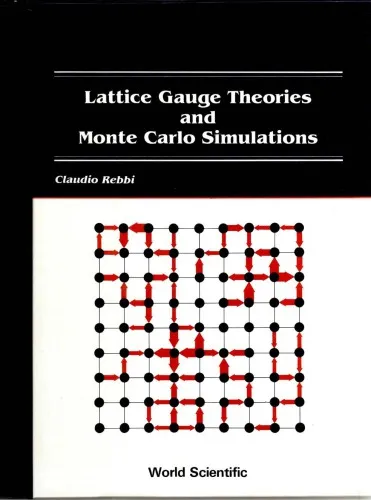
Lattice gauge theories and Monte Carlo simulations
Claudio Rebbi
English
Beginner
Physics
4.6 / 5
0 reviews
1983
Published
675
pages
448
views
Welcome to the fascinating world of lattice gauge theories and Monte Carlo simulations, an essential domain of theoretical physics that has dramatically transformed our understanding of non-perturbative phenomena in quantum field theories. This book serves as a comprehensive gu
Before you read
What will you get from this book?
Welcome to the fascinating world of lattice gauge theories and Monte Carlo simulations, an essential domain of theoretical physics that has dramatically transformed our understanding of non-perturbative phenomena in quantum field theories. This book serves as a comprehensive guide to understanding these complex and intriguing topics.
Detailed Summary of the Book
The book delves into two primary subjects: lattice gauge theories and Monte Carlo simulations, exploring their powerful roles in modern physics. Lattice gauge theory provides a discrete space-time framework, making it possible to perform numerical simulations of quantum field theories. This approach has proven especially useful in understanding quantum chromodynamics (QCD), the theory that describes the strong interactions in subatomic particles.
Monte Carlo simulations come into play by offering computational techniques to approximate solutions to complex problems using random sampling. Combined with lattice models, these simulations enable physicists to tackle problems that are otherwise analytically intractable.
The book is meticulously structured to progress from fundamental concepts to more advanced topics. Initial chapters offer a primer on gauge theories and their discretization on lattices. Subsequent sections delve into Monte Carlo methods, discussing algorithms and statistical techniques crucial for reducing computational errors.
Throughout the book, readers will find practical examples that illustrate the synergy between lattice theories and Monte Carlo simulations. Alongside theoretical discussions, the text sheds light on various simulation algorithms and their application, enabling a deep understanding of phenomena such as confinement and spontaneous symmetry breaking in quantum field theories.
Key Takeaways
The book offers several key takeaways for enthusiasts and professionals in the field of theoretical physics:
- Comprehensive understanding of lattice gauge theories and their importance in modeling quantum field phenomena.
- Insight into various Monte Carlo simulation techniques, their challenges, and their role in reducing uncertainties in theoretical computations.
- The capability to connect theoretical knowledge with practical simulations, leading to more robust and reliable results in particle physics.
Famous Quotes from the Book
"In the discrete world of lattice theories, the continuum challenges of quantum dynamics become approachable, unraveling the complexities of the strong force step by enlightened step."
"Monte Carlo simulations, with their stochastic precision, allow us to peek into the seemingly indomitable realms of the quantum world, offering glimpses with each calculated iteration."
Why This Book Matters
In a field as intricate as theoretical physics, understanding the tools and paradigms that allow us to glimpse the hidden patterns of the universe is immensely valuable. 'Lattice Gauge Theories and Monte Carlo Simulations' stands as a crucial resource because it bridges the gap between abstract theoretical concepts and their computational realizations.
This book is pivotal for those who wish to further their research in particle physics, offering a robust foundation for investigating non-perturbative aspects of quantum field theories. The techniques discussed not only improve comprehension of existing theories but also pave the way for developing new models and hypotheses in physics.
With its balance of theory and computational practice, this book is an indispensable asset to both seasoned physicists and new entrants into the field. Its structured approach and emphasis on the symbiosis between lattice theories and Monte Carlo methods offer a clear path for addressing unanswered questions in high-energy physics.
Ask this book
Your question is answered in the context of this title and author. Each answer uses 2 points.
Sign in to ask the book assistant.
Reader reviews
0 reviews, 4.6 average out of 5
No reviews yet
If you have read this book, help the next reader with your experience.
Write a review
Sign in to publish a review.
Reader questions and answers
Ask a focused question and learn from the community.
Sign in to ask or answer a question.
No questions yet
Be the first to ask a clear, useful question.
What to read next
Related references that continue this learning path.
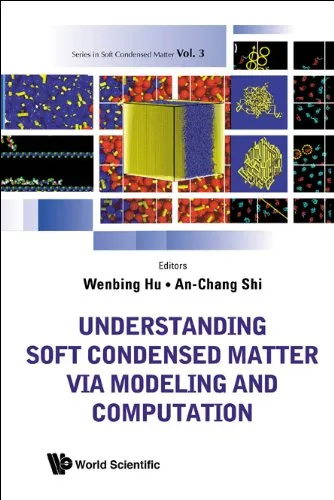
Understanding Soft Condensed Matter Via Modeling and Computation (Series in Soft Condensed Matter 3)
Wenbing Hu,An-Chang Shi,Editors
2010
View book