

Gray's Anatomy for Students: With STUDENT CONSULT Online Access, 2e
Drake, Richard Lee;Mitchell, Adam W. M.;Vogl, Wayne;Gray, Henry
2010
View book
Book guide and evaluation
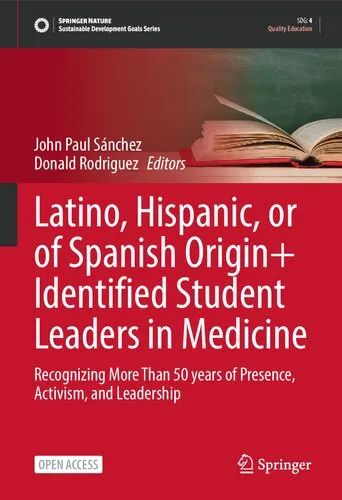
John Paul Sánchez (editor),Donald Rodriguez (editor)
0 reviews
Published
pages
views
Introduction The book Latino, Hispanic, or of Spanish Origin+ Identified Student Leaders in Medicine: Recognizing More Than 50 years of Presence, Activism, and Leadership shines a crucial spotlight on the instrumental role of Latino, Hispanic, and Spanish-origin individual
Before you read
The book Latino, Hispanic, or of Spanish Origin+ Identified Student Leaders in Medicine: Recognizing More Than 50 years of Presence, Activism, and Leadership shines a crucial spotlight on the instrumental role of Latino, Hispanic, and Spanish-origin individuals in shaping the field of medicine. This work not only highlights their contributions as student leaders in a discipline often underrepresented by their communities but also honors the resilience, dedication, and transformative spirit of these trailblazers. The book aligns with the Sustainable Development Goals (SDGs) by addressing issues of equity, inclusivity, and social justice within medical education and healthcare systems.
By delving into personal narratives, historical milestones, and transformative activism, this book uplifts the voices of future healthcare leaders while providing a critical reflection on the systemic challenges faced by underrepresented populations. It aims to foster an inclusive environment where diversity thrives and where student leaders become catalysts for meaningful change.
This compelling narrative serves as both a historical archive and a motivational framework, chronicling the impact of Latino, Hispanic, and Spanish-origin+ identified student leaders over the past half-century. The book documents their rise against systemic barriers, such as racial bias and unequal access to educational resources, to push forward a more equitable healthcare system. At its core, this book is a testament to the perseverance of these leaders who refused to accept disparities as an immutable status quo. Through their actions, they carved paths for others to follow.
The book is structured around pivotal themes, including advocacy, education, and leadership. It thoughtfully examines the intersection of culture and medicine while presenting case studies and interviews to emphasize personal and collective efforts in creating change. Readers will find inspiring stories of student-led initiatives—from grassroots movements to national campaigns—that have shaped policies and improved educational and professional opportunities for the Latino/Hispanic community.
Particular attention is given to the evolution of leadership roles concerning institutional change, health equity, and broader societal transformation. The book also positions these contributions within a global framework, linking the struggles and triumphs of Latino and Hispanic student leaders to the broader goals outlined in the United Nations' Sustainable Development Goals.
"Our identity is not a limitation; it is a source of empowerment, a bridge that connects cultures, and a foundation for systemic change in healthcare."
"To lead in medicine as a Latino, Hispanic, or Spanish-origin student is not just about personal success; it is a collective responsibility to uplift communities that have been historically silenced."
"Activism is not an extracurricular activity; for us, it is a lifeline, a reminder that the doors we walk through today were built by the sacrifices of those before us."
As the United States and many other nations continue to grapple with healthcare disparities and systemic inequities, the importance of diverse leadership in medicine cannot be overstated. This book amplifies the voices of Latino and Hispanic student leaders who have contributed significantly to these efforts over the years. Their stories are not merely inspiring but also serve as blueprints for addressing modern challenges within the healthcare ecosystem.
By weaving together history, activism, and future-forward strategies, this book offers a unique perspective on how student leadership can drive institutional reform. It is an essential resource for educators, policymakers, and anyone committed to advancing the role of diversity within medical fields and beyond. Furthermore, by aligning these narratives with the Sustainable Development Goals, the book underscores the universal relevance of these challenges and solutions for creating a better, more inclusive world.
Latino, Hispanic, or of Spanish Origin+ Identified Student Leaders in Medicine stands as an enduring tribute to those who have fought tirelessly for justice, equity, and recognition. Their contributions echo far beyond the walls of academic institutions, creating ripples of impact that are felt globally. For students, educators, and practitioners alike, this book is not only a reflection of history but a call to action for the future.
Your question is answered in the context of this title and author. Each answer uses 2 points.
0 reviews, 4.5 average out of 5
Sign in to publish a review.
Ask a focused question and learn from the community.
Related references that continue this learning path.
Drake, Richard Lee;Mitchell, Adam W. M.;Vogl, Wayne;Gray, Henry

Richard L. Drake;A. Wayne Vogl;Adam W.M. Mitchell
![Cover of Gray’s Anatomy for Students [with Student Consult Online Access]](https://s3.refhub.ir/images/thumb/Gray_s_Anatomy_for_Students__with_Student_Con_2727_FngnAl0.webp)
Richard L. Drake;A. Wayne Vogl;Adam W.M. Mitchell

Richard E. Behrman MD,Robert M. Kliegman MD,Hal B. Jenson MD