
Book guide and evaluation
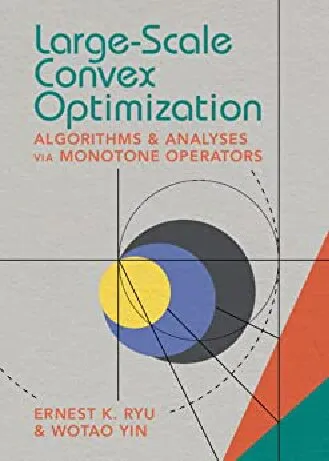
Large-Scale Convex Optimization: Algorithms & Analyses via Monotone Operators
Ernest K. Ryu,Wotao Yin
English
Unordered
Computer Science and Theory
4.7 / 5
0 reviews
2022
Published
319
pages
397
views
Starting from where a first course in convex optimization leaves off, this text presents a unified analysis of first-order optimization methods – including parallel-distributed algorithms – through the abstraction of monotone operators. With the increased computational power and
Before you read
What will you get from this book?
Starting from where a first course in convex optimization leaves off, this text presents a unified analysis of first-order optimization methods – including parallel-distributed algorithms – through the abstraction of monotone operators. With the increased computational power and availability of big data over the past decade, applied disciplines have demanded that larger and larger optimization problems be solved. This text covers the first-order convex optimization methods that are uniquely effective at solving these large-scale optimization problems. Readers will have the opportunity to construct and analyze many well-known classical and modern algorithms using monotone operators, and walk away with a solid understanding of the diverse optimization algorithms. Graduate students and researchers in mathematical optimization, operations research, electrical engineering, statistics, and computer science will appreciate this concise introduction to the theory of convex optimization algorithms.
Ask this book
Your question is answered in the context of this title and author. Each answer uses 2 points.
Sign in to ask the book assistant.
Reader reviews
0 reviews, 4.7 average out of 5
No reviews yet
If you have read this book, help the next reader with your experience.
Write a review
Sign in to publish a review.
Reader questions and answers
Ask a focused question and learn from the community.
Sign in to ask or answer a question.
No questions yet
Be the first to ask a clear, useful question.
What to read next
Related references that continue this learning path.
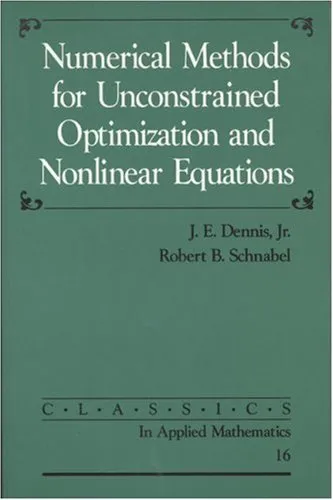
Numerical methods for unconstrained optimization and nonlinear equations
J. E. Dennis,Robert B. Schnabel
1987
View book
CONCUR 2012 – Concurrency Theory: 23rd International Conference, CONCUR 2012, Newcastle upon Tyne, UK, September 4-7, 2012. Proceedings
Jos C. M. Baeten,Bas Luttik,Paul van Tilburg (auth.),Maciej Koutny,Irek Ulidowski (eds.)
2012
View book