Book guide and evaluation
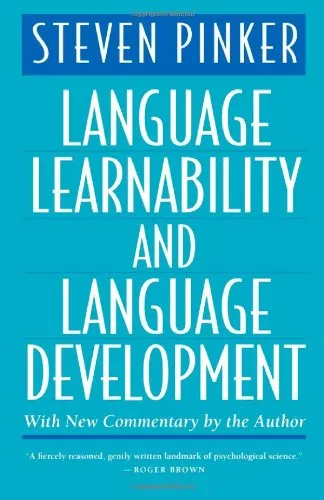
Language learnability and language development
Steven Pinker
English
Unordered
Computer Science and Theory
4.9 / 5
0 reviews
1996
Published
474
pages
563
views
At first glance, this appeared to be a more formidable effort than "The Language Instinct", which seemed aimed at a very wide (and perhaps more credulous) audience.However, the argument seems fairly simple:1. A grammar can be abstracted from speech (in this case, English speech)
Before you read
What will you get from this book?
At first glance, this appeared to be a more formidable effort than "The Language Instinct", which seemed aimed at a very wide (and perhaps more credulous) audience.However, the argument seems fairly simple:1. A grammar can be abstracted from speech (in this case, English speech) based on observed regularities. 2. We can observe a change in a child's speech as he/she moves from simpler to more complex grammatical forms. So we can identify each such change in terms of the starting and ending forms. 3. For any such changes, we surmise the child has come up with one or more rules to enable him/her to acquire the more complex form. The focus seems to be predominantly on the lexical and syntactical forms. Semantics seemed to be mentioned but not much of a concern here. Behaviorists, on the other hand, tend to emphasize the function of speech (although not discounting the importance of syntax). So, as a probably very naive example, consider a child who can say "Give me the apple". Pinker may have noted that the syntax is correct but omits the use of an adjective. Skinner may be wondering whether the child's statement will be reinforced by being given an apple. Now suppose at some later time there are two apples in sight, a red one and a green one. The child now says "Give me the red apple." Pinker has never heard the child use an adjective before and notes that as a development in language acquisition. Skinner wonders if the child's statement will be reinforced by being given the red apple and may be pleased to see that child was able to request that red one. The child's syntax, for whatever reason, was correct but it happened in service of the child's request for an apple. It's wonderful he/she was able to say it in that way, but it also seems wonderful that he/she got an apple. In such a situation, one can really see the red apple. One can really hear the child ask for it and really see the child get it. One really heard the request. How real was the syntax? Well, it may not be explicit in the sense the child or listener are aware of it as syntax. But it may make a big difference if the syntax were wrong in that the child's request could fail. So perhaps we can say the syntax is real (and diagram it if we like). Now can we say that the rule is real that allowed the child to go from the request without the adjective to the request with the adjective. Maybe, but it seems less clear. It also seems less clear how the child made the step. Did he/she create the rule somehow using an innate langauge ability? Or did he/she imitate something he/she had heard? But what if the child had heard a request for a "green apple" and could tell what "red" was but had never heard of a "red apple". Or what if the child had heard of a "red apple". Now I've gotten myself into trouble. Do I turn to Pinker or Skinner for the answer? Is it an either/or? Does it matter that the child wants something to eat or only that he/she is demonstrating an innate capacity for grammar? So where did the syntax come from? Where did the rules come from? Who ate the apple?Grammarians find grammar. Cognitive scientists find mind. One way or another, the child got the apple. Which of these does natural selection seem to favor?
Ask this book
Your question is answered in the context of this title and author. Each answer uses 2 points.
Sign in to ask the book assistant.
Reader reviews
0 reviews, 4.9 average out of 5
No reviews yet
If you have read this book, help the next reader with your experience.
Write a review
Sign in to publish a review.
Reader questions and answers
Ask a focused question and learn from the community.
Sign in to ask or answer a question.
No questions yet
Be the first to ask a clear, useful question.
What to read next
Related references that continue this learning path.