Cause for Success: 10 Companies That Put Profit Second and Came in First
Christine Arena
2011
View book
Book guide and evaluation
Avery Kolers
0 reviews
Published
pages
views
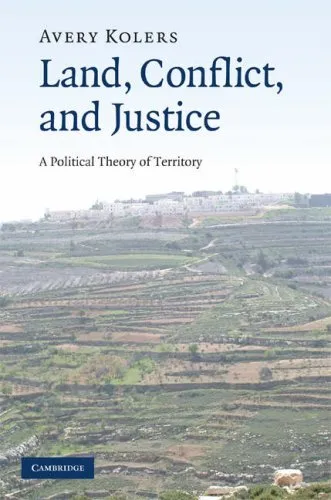
Introduction to 'Land, Conflict, and Justice: A Political Theory of Territory' Welcome to an engaging exploration of what makes land and territory integral to our understanding of political justice. In my book, 'Land, Conflict, and Justice: A Political Theory of Territory,
Before you read
Welcome to an engaging exploration of what makes land and territory integral to our understanding of political justice. In my book, 'Land, Conflict, and Justice: A Political Theory of Territory,' I delve into the intricacies of territorial rights and how they intersect with issues of conflict, identity, and justice.
The book addresses the fundamental question of why territories matter in the wide spectrum of political theory. At its core, it seeks to unravel the complexities surrounding the ownership and control of land, particularly focusing on the philosophical underpinnings that justify or challenge claims to territory. From indigenous land rights to nation-state boundaries, the discussions extend across themes such as historical claims, cultural significance, and economic utility.
The structure of the book walks readers through a theoretical framework that highlights the intertwining of ecological considerations with political legitimacy. By exploring case studies and real-world applications, the narrative provides a pragmatic approach to understanding territorial conflicts. It critiques existing theories while offering fresh paradigms, particularly around the 'attachment theory,' which suggests that people's connections to land should play a significant role in territorial entitlements.
Ultimately, the book posits that justice in territorial claims involves a combination of historical rectification, forward-looking sustainability, and cultural respect. It argues for a balanced approach that considers the aspirations and grievances of all stakeholders involved.
“Territory is not merely a backdrop for human action; it is a vibrant participant in shaping social justice and injustice.”
“The right to a territory is intimately connected to the identity and dignity of a people.”
“A fair theory of territory must reconcile the scales of history with the immediacy of ecological and cultural viability.”
With ongoing territorial disputes around the globe, the theoretical foundations laid in 'Land, Conflict, and Justice' provide essential insights into one of the most pressing issues of our time. This book challenges readers, be they scholars, policymakers, or the public, to rethink conventional wisdom about land and conflict. It underscores the urgent need for novel approaches to age-old struggles over land.
Moreover, it contributes to the broader discourse on justice and peace by offering a framework that does not merely hinge on legality but also on moral and cultural dimensions. By addressing varied instances of land disputes, from colonial histories to modern geopolitical tensions, the book offers something for anyone interested in the foundations of a just society.
In a world where resources are finite and disputes often arise from competing territorial claims, 'Land, Conflict, and Justice' strives to bridge gaps in understanding and action, compelling us to consider justice as a guiding principle in resolving such conflicts. This comprehensive exploration affirms its significance not only in political theory but in the pursuit of harmony and equity across the globe.
Your question is answered in the context of this title and author. Each answer uses 2 points.
0 reviews, 4.0 average out of 5
Sign in to publish a review.
Ask a focused question and learn from the community.
Related references that continue this learning path.
Christine Arena