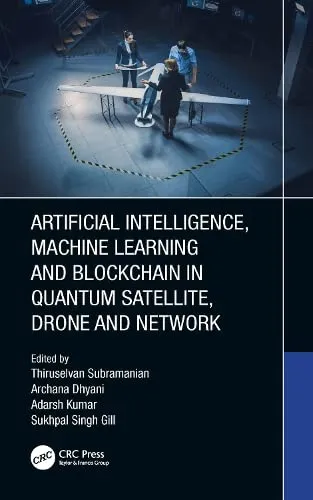
Artificial Intelligence, Machine Learning and Blockchain in Quantum Satellite, Drone and Network
Thiruselvan Subramanian,Archana Dhyani,Adarsh Kumar,Sukhpal Singh Gill
2022
View book
Book guide and evaluation
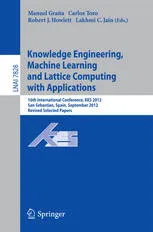
Tadeusz Lasota,Zbigniew Telec,Bogdan Trawiński,Grzegorz Trawiński (auth.),Manuel Graña,Carlos Toro,Robert J. Howlett,Lakhmi C. Jain (eds.)
0 reviews
Published
pages
views
Introduction Welcome to "Knowledge Engineering, Machine Learning and Lattice Computing with Applications," a comprehensive tome derived from the 16th International Conference, KES 2012, held in the vibrant city of San Sebastian, Spain. This collection of revised se
Before you read
Welcome to "Knowledge Engineering, Machine Learning and Lattice Computing with Applications," a comprehensive tome derived from the 16th International Conference, KES 2012, held in the vibrant city of San Sebastian, Spain. This collection of revised selected papers stands at the frontier of advancing technologies, capturing significant advancements in the realms of knowledge engineering, machine learning, and lattice computing. Compiled and edited by preeminent scholars, this book encapsulates pioneering research and applied innovations that address contemporary challenges within these fields.
This book serves as a pivotal resource that amalgamates varied insights from experts who have spearheaded advancements in computational intelligence. The compendium is subdivided into thematic layers exploring the theoretical foundations and practical applications of knowledge engineering. It delves deeply into methodologies for designing intelligent systems that emulate human decision-making processes.
Machine learning, a core facet of artificial intelligence, is thoroughly scrutinized throughout the chapters. Contributions explore both supervised and unsupervised learning techniques, emphasizing novel algorithms that promise enhanced accuracy and efficiency. Lattice computing, a lesser-known but increasingly significant computational paradigm, is dissected to reveal its potential in solving complex, multi-dimensional problems that traditional methods struggle to address.
The conference proceedings also spotlight application-driven research, showcasing innovative implementations across various sectors. Scholars and practitioners present cases where these technologies are harnessed to optimize industrial processes, improve healthcare systems, and enrich user interactions with technology.
Readers of this volume will acquire a comprehensive understanding of how contemporary computational techniques are being applied to real-world issues. The key takeaways include:
The book is rich with insights and reflections. Here are a few notable quotes:
"The intersection of knowledge and machine learning represents the dawn of a new era in artificial intelligence, where machines not only process but understand data."
"Lattice computing paves the way for a structured approach to embracing complexity in multi-dimensional data analysis."
In a world increasingly driven by data, understanding the sophisticated techniques laid out in this book is invaluable. It serves as both a reference and a source of inspiration for researchers, students, and professionals keen on exploring and contributing to the field of computational intelligence. The book not only highlights current trends but also provokes thought on future developments, making it a significant contribution to academic literature and practical innovation.
By bridging theoretical frameworks with practical applications, "Knowledge Engineering, Machine Learning and Lattice Computing with Applications" opens doors for technological advancement. Its insights foster an environment where cross-disciplinary collaboration can thrive, enhancing our ability to solve pressing challenges and improve quality of life through intelligent technology.
Your question is answered in the context of this title and author. Each answer uses 2 points.
0 reviews, 3.5 average out of 5
Sign in to publish a review.
Ask a focused question and learn from the community.
Related references that continue this learning path.
Thiruselvan Subramanian,Archana Dhyani,Adarsh Kumar,Sukhpal Singh Gill

Sebastian Raschka,Vahid Mirjalili