
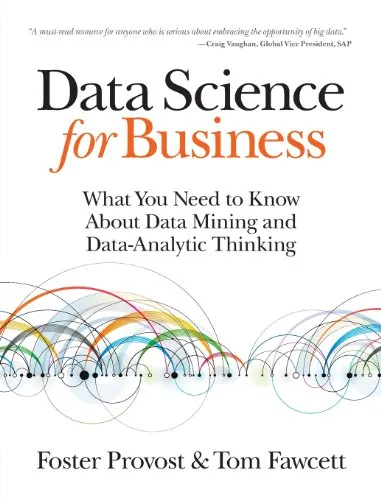
Data Science for Business: What you need to know about data mining and data-analytic thinking
Foster Provost,Tom Fawcett
2013
View book

Book guide and evaluation
Sunita Sarawagi (auth.),Bart Goethals,Arno Siebes (eds.)
0 reviews
Published
pages
views
Introduction Welcome to Knowledge Discovery in Inductive Databases: Third International Workshop, KDID 2004, a comprehensive collection of revised selected and invited papers from the KDID 2004 workshop held in Pisa, Italy. This book delves deep into the cutting-ed
Before you read
Welcome to Knowledge Discovery in Inductive Databases: Third International Workshop, KDID 2004, a comprehensive collection of revised selected and invited papers from the KDID 2004 workshop held in Pisa, Italy. This book delves deep into the cutting-edge advancements of knowledge discovery and presents innovative approaches in the realm of inductive databases. The KDID series continues to provide essential insights into methods for seamless integration of data mining and database systems, fostering a stronger connection between theoretical research and practical applications.
As we navigate through this compilation, we witness both foundational work and contemporary breakthroughs in the field. By focusing on inductive databases, the contributors aim to extend classical database systems by integrating data mining functionalities directly within the database framework. This approach fosters an environment where data exploration, pattern discovery, and hypothesis testing occur in a unified, efficient manner. The proceedings from KDID 2004 highlight significant research in this direction and serve as a cornerstone for anyone interested in the interdisciplinary field of data mining and database systems.
The book encapsulates a series of scholarly contributions focusing on the integration of data mining tasks with traditional database systems, a field that stands at the intersection of artificial intelligence, database management, and data science. By presenting refined versions of the papers reviewed and discussed at KDID 2004, this book delivers an intellectually rich collection of ideas that both academics and professionals in the field will find invaluable.
Topics range from theoretical explorations of inductive principles to applied techniques for improving database efficiency and usability. Core areas of focus include multi-relational data mining, constraint-based mining techniques, declarative query languages tailored for data mining tasks, and optimization algorithms. The contributors address practical challenges such as scalability, interpretability, and computational overheads, offering realistic solutions for large-scale industrial data repositories.
Across its well-structured chapters, the book ventures into:
This book is not only an excellent resource for researchers but also provides practitioners with actionable insights into deploying advanced functionality in real-world database environments.
Readers of this book will come away with a wealth of knowledge about the interplay between data mining methodologies and database technology. Some of the key takeaways include:
These takeaways underline the practical value of the book as a resource for advancing both academic and industrial pursuits.
"The integration of data mining and database systems will not only optimize performance but also radically alter the way we manage and extract insights from data."
"Inductive databases empower analysts to pose complex analytical transformations as part of their querying process, bridging the gap between data retrieval and knowledge discovery."
Data is the lifeblood of modern enterprises, and the ability to efficiently extract meaningful patterns directly impacts the success of any data-driven decision-making process. This book stands at the forefront of efforts to seamlessly meld data mining with database technology, allowing analysts to derive actionable insights without the need to move data between separate systems.
The concepts outlined in this volume are particularly relevant in today's era of big data and artificial intelligence. As organizations increasingly rely on automated systems for sifting through massive datasets, inductive databases offer a paradigm shift toward more intelligent, context-aware processing frameworks. By advancing both theoretical and practical perspectives, the book contributes to a deeper understanding of how we can manage and extract value from complex data structures.
Whether you are a seasoned researcher or a practitioner seeking to deploy cutting-edge data mining solutions, this book offers a pathway to explore and implement innovative methodologies.
Your question is answered in the context of this title and author. Each answer uses 2 points.
0 reviews, 4.0 average out of 5
Sign in to publish a review.
Ask a focused question and learn from the community.
Related references that continue this learning path.
Foster Provost,Tom Fawcett
Galit Shmueli,Peter C. Bruce
Glenn J. Myatt,Wayne P. Johnson
Sankar K. Pal,Pabitra Mitra