Book guide and evaluation
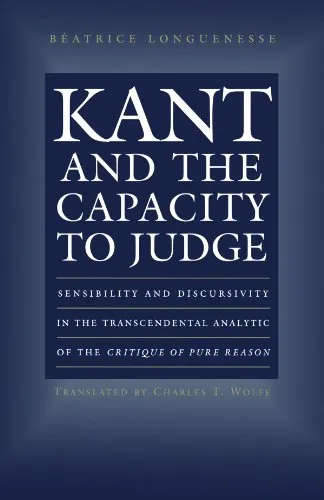
Kant and the Capacity to Judge: Sensibility and Discursivity in the Transcendental Analytic of the "Critique of Pure Reason"
Beatrice Longuenesse
English
Beginner
Logic and Foundations
4.5 / 5
0 reviews
2001
Published
218
pages
735
views
Welcome to an in-depth introduction of 'Kant and the Capacity to Judge: Sensibility and Discursivity in the Transcendental Analytic of the "Critique of Pure Reason."' This book, authored by Beatrice Longuenesse, embarks on an intellectual journey through Immanuel Kant's groun
Before you read
What will you get from this book?
Welcome to an in-depth introduction of 'Kant and the Capacity to Judge: Sensibility and Discursivity in the Transcendental Analytic of the "Critique of Pure Reason."' This book, authored by Beatrice Longuenesse, embarks on an intellectual journey through Immanuel Kant's groundbreaking theories, specifically focusing on his notions of sensibility and discursivity. It offers a critical exploration of Kant's first Critique by delving into how these crucial faculties interplay to form judgments.
Detailed Summary of the Book
Kant's "Critique of Pure Reason" remains one of the most essential works in philosophy, and in "Kant and the Capacity to Judge," Beatrice Longuenesse provides a comprehensive analysis of the role played by sensibility and discursivity within this central text. The book is meticulously structured to unveil the intricacies of Kant's arguments surrounding human cognition and the conditions under which knowledge is possible. Longuenesse systematically explores the Transcendental Analytic, the section in which Kant elaborates on how categories of the understanding interact with sensory input to produce coherent knowledge.
At the heart of Longuenesse's exploration is the concept of 'judgment,' a cornerstone of Kantian philosophy. She argues that Kant's entire epistemological project can be regarded as a defense of the capacity to judge, where sensibility refers to the passive reception of objects through intuition, and discursivity refers to the active use of concepts. Longuenesse investigates how these faculties coalesce to synthesize knowledge and challenges some traditional interpretations of Kant by emphasizing the dynamic interrelation rather than a hierarchical structure.
Key Takeaways
- The book highlights the essential tension and mutual dependency between sensibility and discursivity, advocating for a nuanced understanding of Kant's philosophy.
- It sheds light on Kant's concept of synthesis, demonstrating its central role in the unification of perceptive and conceptual elements of human cognition.
- Longuenesse provides a novel interpretation of Kant's Deduction of the Categories, challenging pre-existing readings and offering fresh insights.
- The examination enhances understanding of the Transcendental Analytic's purpose and its implications for the broader philosophical discussions in epistemology.
Famous Quotes from the Book
"Judgment is the faculty by which representations are brought to the unity of consciousness. In this, it fulfills a role that is not merely mediatory but constitutive of experience."
"Kant's project is best understood as an exploration of the powers and limits of human cognition insofar as it is guided by the twin poles of receptivity and spontaneity."
Why This Book Matters
"Kant and the Capacity to Judge" holds a significant place in philosophical literature because it provides a comprehensive and accessible analysis of Kant's first Critique, particularly the complex interplay between sensibility and discursivity. By offering a fresh interpretation of the Deduction of the Categories, Longuenesse enhances our understanding of Kant’s epistemological framework and the foundation of human cognition. Her work illuminates the depth and intricacies of Kant's theories, making them more approachable to both scholars and students eager to engage with Kantian philosophy deeply.
The book's insights into judgment as a critical faculty expand our appreciation of how we process and unify the manifold of intuition into coherent knowledge. Longuenesse's exploration aids readers in grasping the significance of Kant's thoughts in the context of both historical and contemporary philosophical debate. As such, this book is not just an analysis of Kant's work, but a contribution to ongoing discussions in philosophy about the nature and limits of human cognition.
Ask this book
Your question is answered in the context of this title and author. Each answer uses 2 points.
Sign in to ask the book assistant.
Reader reviews
0 reviews, 4.5 average out of 5
No reviews yet
If you have read this book, help the next reader with your experience.
Write a review
Sign in to publish a review.
Reader questions and answers
Ask a focused question and learn from the community.
Sign in to ask or answer a question.
No questions yet
Be the first to ask a clear, useful question.
What to read next
Related references that continue this learning path.
The conflicts of modernity in Ludwig Wittgenstein's Tractatus Logico-Philosophicus
Dobrzeniecki,Marek
2016
View book