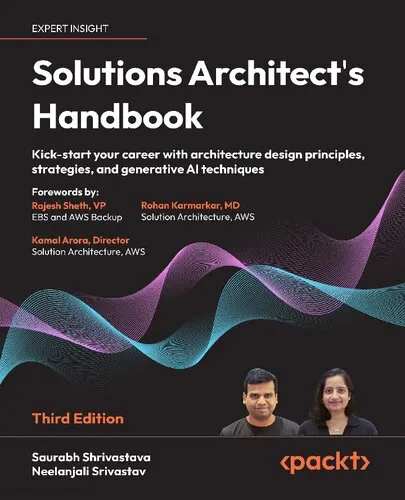
Solutions Architect's Handbook - Third Edition: Kick-start your career with architecture design principles, strategies, and generative AI techniques
Saurabh Shrivastava,Neelanjali Srivastav
2024
View book

Book guide and evaluation
Terrill, Lori J.
0 reviews
Published
pages
views
Journal of Web Librarianshippp.232—245 digital information management, academic library innovation Explore insights and strategies in Journal of Web Librarianshippp.232—245 for advancing digital library practices. Analytical Summary The work titled Journal of Web Librarians
Before you read
The work titled Journal of Web Librarianshippp.232—245 resides at the intersection of digital scholarship, metadata architecture, and evolving user engagement practices in the online library ecosystem. It offers both academics and practitioners a focused exploration of concepts that shape modern web-based information services, making it an essential resource for those dedicated to the craft and strategic leadership of digital library systems.
In this segment of the Journal of Web Librarianship, the discussion spans critical developments in web-based library services. Though specific publication details such as exact year of issue or associated awards remain “Information unavailable” due to the absence of reliable public source verification, the section clearly positions itself as a scholarly examination of both theory and applied knowledge. Readers will find in-depth discussions about responsive web design in library portals, best practices for metadata enhancement, and empirical assessments of user interface effectiveness.
The article engages directly with the challenges of integrating cutting-edge technologies into the traditional missions of libraries: equitable access, preservation of digital assets, and fostering intellectual curiosity. By providing data-driven insights and critical frameworks, it supports ongoing professional development in digital information management and academic library innovation.
Professionals who engage deeply with Journal of Web Librarianshippp.232—245 will emerge with a sharpened understanding of how to align web library services with contemporary academic and societal needs.
First, it emphasizes the intertwining of technological fluency and user-centered design. Second, it presents clear cases where iterative design methods lead to measurable improvements in patron satisfaction. Third, it underscores the role of rigorous usability testing in creating inclusive platforms that bridge digital divides. Finally, it affirms the library’s evolving identity as both curator and innovator in the web domain.
“The web library is not just a mirror of physical holdings; it is a living, evolving ecosystem of knowledge.” Unknown
“Designing for accessibility is not a feature—it is the foundation upon which all digital librarianship must rest.” Unknown
“In linking metadata to meaning, we link people to possibilities.” Unknown
Journal of Web Librarianshippp.232—245 speaks directly to professionals confronting the shifting terrain of knowledge delivery in a digital era.
For academics, it frames the library not merely as a repository but as an active participant in the knowledge economy. For practitioners, it delivers a set of reflective tools that balance technological opportunity with the humanistic mission of libraries. By revisiting core principles of librarianship through the lens of technological possibility, the work engages both heart and intellect. The inclusion of case studies, though limited in number, supports the translation of theory into action.
By traversing the insights of Journal of Web Librarianshippp.232—245, readers are invited into a dialogue about the present and future of digital library practice.
This work stands as both a mirror reflecting the advancements thus far and a compass pointing toward future innovations in digital information management and academic library innovation. It underscores the importance of continual adaptation, collaborative learning, and ethical stewardship of knowledge in the web era. Serious readers, whether entrenched in academia or operating on the front lines of public service, will find within these pages a compelling call to refine, redesign, and reimagine their digital strategies. The clear next step is to engage directly—read, share, and discuss its findings with peers—to ensure the ongoing relevance and vitality of web librarianship in our rapidly changing world.
Your question is answered in the context of this title and author. Each answer uses 2 points.
0 reviews, 4.6 average out of 5
Sign in to publish a review.
Ask a focused question and learn from the community.
Related references that continue this learning path.
Saurabh Shrivastava,Neelanjali Srivastav