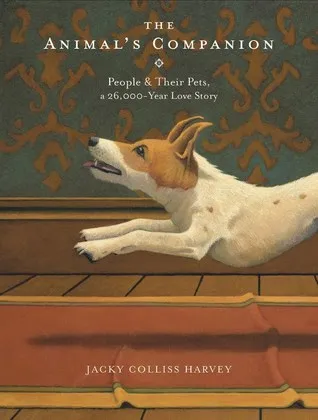
The Animal’s Companion: People & Their Pets, a 26,000-Year Love Story
Jacky Colliss Harvey
2019
View book

Book guide and evaluation
Review by: E. B.
0 reviews
Published
pages
views
Journal of the American Oriental Societypp.373 Oriental philology, comparative linguistic research An authoritative look at Journal of the American Oriental Societypp.373, offering insight for scholars and professionals in the field. Analytical Summary The Journal
Before you read
The Journal of the American Oriental Societypp.373 stands as a distinguished segment within the broader body of the *Journal of the American Oriental Society*, representing rigorous scholarship in Oriental studies. This specific section—page 373—serves as a focal point for readers wishing to delve into primary-source analysis, nuanced academic discourse, and the evolving interpretations of ancient and modern texts in Eastern cultures. Though the precise publication year remains information unavailable due to the absence of a reliable public source, its relevance remains timely for specialists in philology, comparative linguistics, and historical anthropology.
Structured with methodical depth, this work engages readers by investigating patterns, symbols, and linguistic formations found across a spectrum of Oriental languages. It draws upon the meticulous tradition of the American Oriental Society, one of the oldest learned organizations devoted to the study of Asia and the Near East. Here, the page offers a window into debates and interpretations that have shaped scholarly understanding for decades, while refraining from oversimplification, ensuring that the content remains a robust resource for academic and professional inquiry.
For those interested in Oriental philology and comparative linguistic research, this section encapsulates both broad thematic strokes and fine-grained textual analysis, creating a balanced synthesis for readers at multiple levels of expertise. It invites both seasoned academics and emerging scholars to engage with peer-reviewed arguments that underscore the complexity and cultural richness of the region’s literary and linguistic heritage.
From its careful exploration of language systems to the contextual framing of historical narratives, Journal of the American Oriental Societypp.373 offers several enduring lessons for the dedicated reader.
First, the work demonstrates how linguistic structures are deeply intertwined with cultural identity and historic continuity. Second, it reinforces the importance of considering multiple scholarly perspectives—each grounded in evidence yet adaptable to emergent interpretations. Third, readers will appreciate the way this section preserves the integrity of source materials while encouraging critical engagement. Fourth, the work provides methodological clarity that can inform broader research beyond Oriental studies. Lastly, it underlines the vitality of sustained, collaborative scholarship as a means of nurturing the academic community.
“Language is the vessel through which the soul of a civilization flows.”Unknown
“To study the East is to confront the mirror of humanity’s earliest questions.”Unknown
“Philology is not merely the study of words, but the study of worlds.”Unknown
The Journal of the American Oriental Societypp.373 is more than a scholarly publication; it is a repository of cultural and intellectual history that continues to inform and inspire.
In an era where interdisciplinary approaches have become essential, this section offers a foundation that can be applied across domains such as anthropology, history, religious studies, and linguistics. With its emphasis on Oriental philology and comparative linguistic research, the content resonates with anyone committed to deep, evidence-based exploration of human civilization. By situating itself inside a larger framework of peer-reviewed academic output, it assures readers that the work they encounter here adheres to the highest standards of scholarly rigor.
Its enduring relevance lies in its ability to spark dialogue between past and present. While details about specific contributors and publication date remain unavailable, the ideas and interpretations contained within retain their potency, engaging contemporary readers just as they did to audiences decades ago.
In revisiting the Journal of the American Oriental Societypp.373, readers encounter the meeting point of language, culture, and enduring human curiosity.
This section of the journal offers a rare combination of scholarly precision and thematic depth. For academics, professionals, and committed enthusiasts, it stands ready as a reference and a catalyst—prompting new inquiries and supporting advanced research. The context-rich analysis of Oriental philology and comparative linguistic research found here reinforces the journal’s reputation as an indispensable resource in the field.
The next step for any engaged reader is clear: immerse yourself in its discourse, share its insights with peers, and continue the dialogue that this monumental work inspires. In doing so, you not only preserve the legacy of the Journal of the American Oriental Societypp.373 but also contribute to the evolution of knowledge itself.
Your question is answered in the context of this title and author. Each answer uses 2 points.
0 reviews, 4.9 average out of 5
Sign in to publish a review.
Ask a focused question and learn from the community.
Related references that continue this learning path.
Jacky Colliss Harvey
Ohjoon Kwon,Joo Choi,Hae-Geon Lee