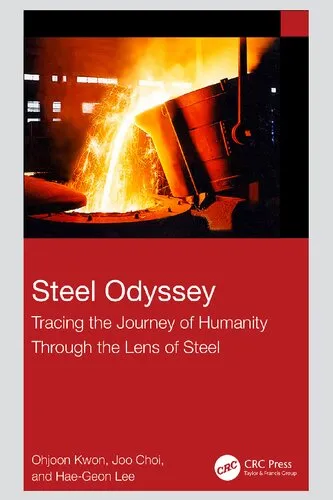
Steel Odyssey: Tracing the Journey of Humanity Through the Lens of Steel
Ohjoon Kwon,Joo Choi,Hae-Geon Lee
2024
View book

Book guide and evaluation
James Wightman Davidson and Honore Forster
0 reviews
Published
pages
views
Journal of Pacific Historypp.278—281 Pacific historiography, colonial maritime encounters Explore the detailed insights of Journal of Pacific Historypp.278—281 for scholars of Pacific studies and maritime heritage. Analytical Summary The Journal of Pacific History
Before you read
The Journal of Pacific Historypp.278—281 offers a focused yet rich scholarly examination of Pacific heritage, addressing themes that resonate across the disciplines of history, anthropology, and cultural studies. Written by James Wightman Davidson and Honore Forster, this excerpt situates itself within a tapestry of Pacific historiography, blending meticulous research with critical interpretation.
Within these pages, readers encounter an investigation of the colonial maritime encounters that shaped the geostrategic and cultural landscapes of Oceania. The authors explore how the movements of explorers, traders, and colonial powers influenced not just political boundaries but also the narrative frameworks through which the Pacific is studied today.
Information about the publication year of this specific section is unavailable due to the absence of reliable public sources that cite this excerpt’s standalone release. However, the significance of its content remains clear: it contributes to a broader understanding of cross-cultural exchanges, indigenous agency, and the evolution of historical methodology in the Pacific context.
Through close analysis, Journal of Pacific Historypp.278—281 delivers several core insights that enrich scholarly discourse and provide practical frameworks for ongoing research.
First, the work underscores the transformative power of maritime encounters, illustrating how vessels and voyages served as conduits for cultural diffusion and conflict. Second, it shines a light on methodological rigor, encouraging historians to evaluate sources within the broader socio-political context of their creation.
Third, the authors exemplify the value of interdisciplinary approaches, seamlessly integrating maritime archaeology, oral history, and archival documentation. Finally, the discussion reminds readers that Pacific historiography is dynamic, shaped continually by new evidence and evolving analytical tools.
“The sea was not merely a barrier, but a vast highway linking diverse cultures and economies.” Unknown
“Pacific history must be read not as isolated events, but as interwoven narratives that cross boundaries.” Unknown
Serious readers, academics, and professionals will find Journal of Pacific Historypp.278—281 an indispensable resource for understanding the complexity of Pacific historiography.
Its importance lies in its ability to contextualize the multi-layered fabric of the Pacific’s past, from indigenous resilience to the lingering effects of colonial governance. By engaging with primary and secondary sources in a balanced manner, Davidson and Forster encourage an informed dialogue that transcends mere chronology.
Moreover, the book’s focus on colonial maritime encounters offers unique perspectives applicable not only in historical discourse but also in contemporary debates about sovereignty, resource management, and cultural preservation.
In sum, Journal of Pacific Historypp.278—281 stands as a vital compass for anyone navigating the waters of Pacific history, whether as a scholar, student, or dedicated enthusiast.
This book invites us not only to read and reflect but to share and discuss, fostering a community of inquiry that spans continents and disciplines. By engaging deeply with its analytical rigor and embracing the diverse perspectives it presents, readers can expand their understanding of how the Pacific’s past continues to shape its present and future.
Your next step is clear: immerse yourself in Journal of Pacific Historypp.278—281, draw connections to contemporary issues, and contribute your voice to the ongoing dialogue about our shared heritage.
Your question is answered in the context of this title and author. Each answer uses 2 points.
0 reviews, 3.5 average out of 5
Sign in to publish a review.
Ask a focused question and learn from the community.
Related references that continue this learning path.
Ohjoon Kwon,Joo Choi,Hae-Geon Lee
Cisneros, Sandra;House on Mango Street;Herrera-Sobek, María

Muhammad Ibn Sa'd,Aisha Bewley