
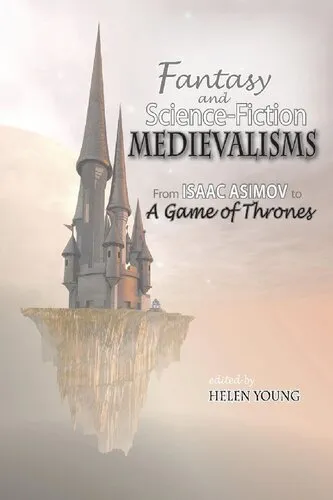
Fantasy and Science Fiction Medievalisms: From Isaac Asimov to A Game of Thrones
Helen Young (editor)
2015
View book

Book guide and evaluation
Stephanie Willman Bordat, Susan Schaefer Davis and Saida Kouzzi
0 reviews
Published
pages
views
Journal of Middle East Women's Studiespp.90—119 Middle Eastern gender studies, women's sociopolitical empowerment An in-depth exploration in the Journal of Middle East Women's Studiespp.90—119 on gender, identity, and empowerment in the region. Analytical Summary
Before you read
The section spanning pages 90—119 of the Journal of Middle East Women's Studies, authored by Stephanie Willman Bordat, Susan Schaefer Davis, and Saida Kouzzi, offers an incisive examination of women’s lived experiences in diverse Middle Eastern contexts. Grounded in rigorous fieldwork, scholarly method, and an interdisciplinary framework, this part of the journal positions itself as more than an academic exercise—it becomes a lens through which readers can critically engage with social, legal, and cultural structures that shape women’s realities.
Through qualitative narratives and analytical interpretation, the authors articulate the complex interplay of tradition, modernity, and reform movements. Their work situates women not as passive subjects of change but as active agents influencing legal reform, community leadership, and the pursuit of rights. Despite the highly specific sociocultural settings, thematic strands such as identity formation, resistance, and legal literacy resonate broadly across borders. Although publication year and recognition details are currently “Information unavailable” due to no reliable public source, the content’s relevance remains undiminished.
Scholars, practitioners, and policymakers will find in this work critical insights for advancing gender equity initiatives and understanding nuanced sociopolitical landscapes.
Firstly, intersectionality emerges as a fundamental framework, demonstrating how gender interacts with class, education, rural/urban divides, and legal systems. Secondly, the text illuminates persistent structural challenges—both formal legal constraints and informal sociocultural norms—that shape women’s opportunities. Thirdly, empowering change is shown to hinge on community-based advocacy coupled with legal literacy campaigns.
Additionally, the authors stress that transnational discourse and localized interventions should coexist, ensuring that grassroots realities are not overshadowed by generalized global narratives. The section also provides case-driven discussions that could inspire comparative research between Middle Eastern and other regional women's studies contexts.
“Understanding women’s agency requires listening, not prescribing.”Unknown
“Legal rights are only as strong as the community’s will to protect them.”Unknown
“Empowerment begins when narratives shift from victimhood to leadership.”Unknown
The importance of pages 90—119 in the Journal of Middle East Women's Studies lies in its capacity to bridge academic discourse and actionable policy ideas. It challenges prevailing stereotypes while providing evidence-based strategies for engagement.
In an academic landscape often dominated by distant theoretical constructs, this work anchors itself in real voices, real struggles, and real victories. The inclusion of secondary themes like Middle Eastern gender studies and women’s sociopolitical empowerment ensures that the research appeals to multidisciplinary audiences—from anthropology and sociology to law and political science. As a result, it functions both as a scholarly resource and as a practical guide for activists and decision-makers.
The Journal of Middle East Women's Studiespp.90—119 invites readers into a profound dialogue on gender, agency, and the power of community. By weaving scholarly analysis with lived realities, the authors create an indispensable resource for those committed to understanding and advancing women’s rights in the Middle East.
For academics, this text can inform lectures, seminars, and research. For professionals and advocates, it provides a roadmap grounded in cultural sensitivity and empirical insights. Most importantly, it inspires readers to not only absorb knowledge but also to act—whether by sharing its findings, discussing its themes in collaborative forums, or employing its lessons in everyday advocacy. Engage with it, reflect on its narratives, and let it inform the ongoing work of building equitable societies.
Your question is answered in the context of this title and author. Each answer uses 2 points.
0 reviews, 4.5 average out of 5
Sign in to publish a review.
Ask a focused question and learn from the community.
Related references that continue this learning path.
Helen Young (editor)

Cisneros, Sandra;House on Mango Street;Herrera-Sobek, María