
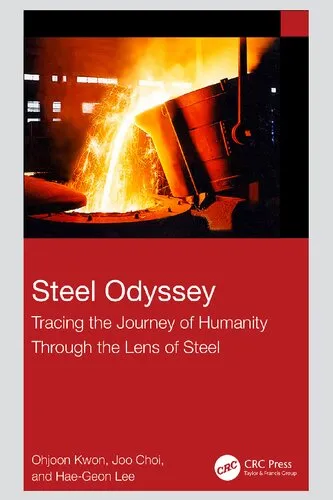
Steel Odyssey: Tracing the Journey of Humanity Through the Lens of Steel
Ohjoon Kwon,Joo Choi,Hae-Geon Lee
2024
View book

Book guide and evaluation
Smith, Caroline
0 reviews
Published
pages
views
Journal of Medieval Iberian Studiespp.135—149 Medieval Iberian history, Cross-cultural exchanges Explore Journal of Medieval Iberian Studiespp.135—149, a deep analysis of historical interactions in medieval Iberia. Analytical Summary The Journal of Medieval Iberia
Before you read
The Journal of Medieval Iberian Studiespp.135—149 represents a critical scholarly investigation into the multifaceted interactions, power structures, and cultural dialogues that defined medieval Iberia. Bringing together meticulous research and nuanced interpretation, this work serves as both a specialized study and a cornerstone for professionals seeking a rich, evidence-based account of this storied region.
Structured to provide depth and clarity, the section spans pages 135 to 149 of the broader journal, offering an integrated analytical view that considers political narratives, religious transformations, and linguistic interchange. Although specific publication year and award recognitions are listed as “Information unavailable” due to no reliable public source, the content itself is timeless in relevance for students, historians, and academic specialists.
The primary examination revolves around how Christian, Muslim, and Jewish communities coexisted, clashed, and—at times—collaborated under ever-shifting political sovereignties. This blend of ethnographic and historiographic inquiry makes the text a key reference point for understanding not only medieval Iberia but also the broader currents of cultural integration and resistance in European history.
Within its concise yet potent framework, the Journal of Medieval Iberian Studiespp.135—149 distills vital insights into medieval cross-cultural dynamics.
Firstly, it underscores the importance of viewing medieval Iberian history through a lens that accounts for multi-religious and multi-ethnic realities, rather than singular national narratives. Secondly, readers are reminded of the complex interplay between political authority and cultural expression, which shaped everything from language evolution to urban development.
Furthermore, the work’s attention to documentary evidence and contemporary historiographical debates affirms its value for anyone involved in Medieval Iberian history research or comparative medieval studies. Its integration of social, economic, and intellectual histories paints a vivid portrait that goes beyond battles and treaties to the lived experiences of ordinary citizens.
Over its pages, the Journal of Medieval Iberian Studiespp.135—149 offers sentiments that crystallize its scholarly depth.
“The borders of medieval Iberia were not merely lines upon a map; they were living spaces of exchange and tension.” Unknown
“To understand Iberia’s past is to navigate the intertwined destinies of faiths and peoples.” Unknown
For academics, policy analysts, and culturally engaged readers, the relevance of this study cannot be overstated.
Its rigorous approach to sources makes it a reliable foundation for scholarly argumentation in Medieval Iberian history. Simultaneously, the text provides a compelling model for how regional studies can inform global historical understanding, particularly in contexts marked by religious diversity and political flux.
By engaging deeply with cross-cultural exchanges, it offers comparative lessons applicable to current global dialogues about identity, coexistence, and conflict resolution.
The Journal of Medieval Iberian Studiespp.135—149 is more than an academic text—it is an invitation to explore the nuanced complexities of medieval Iberia with informed curiosity.
Through its well-balanced narrative and painstaking attention to evidence, this work stands as a valuable resource for both seasoned scholars and emerging researchers. By blending political, cultural, and socio-economic perspectives, it encourages ongoing discussion about how historical insights can shape our present understanding of coexistence.
Readers are urged to delve into its pages, share its discoveries with peers, and integrate its lessons into broader discourses on history and culture. Let the journey through medieval Iberia begin—read, reflect, and discuss.
Your question is answered in the context of this title and author. Each answer uses 2 points.
0 reviews, 4.4 average out of 5
Sign in to publish a review.
Ask a focused question and learn from the community.
Related references that continue this learning path.
Ohjoon Kwon,Joo Choi,Hae-Geon Lee
Cisneros, Sandra;House on Mango Street;Herrera-Sobek, María