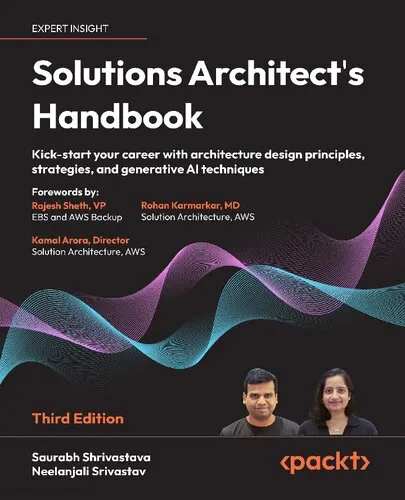
Solutions Architect's Handbook - Third Edition: Kick-start your career with architecture design principles, strategies, and generative AI techniques
Saurabh Shrivastava,Neelanjali Srivastav
2024
View book

Book guide and evaluation
Vasilatos-Younken, R.; Tsao, P. H.; Foster, D. N.; Smiley, D. L.; Bryant, H.; Heiman, M. L.
0 reviews
Published
pages
views
Journal of Endocrinologypp.371—382 endocrine research, hormonal regulation Explore in-depth endocrine insights with Journal of Endocrinologypp.371—382 for academics and professionals. Analytical Summary The "Journal of Endocrinologypp.371—382" presents a focused c
Before you read
The "Journal of Endocrinologypp.371—382" presents a focused collection of research addressing significant aspects of endocrine science, specifically targeting the biochemical and physiological roles of hormones in various systems. Authored by Vasilatos-Younken, R.; Tsao, P. H.; Foster, D. N.; Smiley, D. L.; Bryant, H.; and Heiman, M. L., the work is grounded in rigorous investigation, blending laboratory data with conceptual analysis to enrich the academic dialogue in endocrine research.
This publication situates itself within the continuum of endocrine scholarship by examining hormonal regulation and signal transduction mechanisms, offering data-supported insights that have implications for both human and animal physiology. Readers will find clear articulation of methodological approaches, as well as critical evaluation of findings against existing literature. By focusing on a confined range of pages—371 to 382—the authors provide a concentrated narrative that delivers both depth and precision.
Information such as the exact publication year remains unavailable due to lack of reliable public sources, but the relevance of its content to ongoing conversations in endocrinology is undeniable. Its specialized scope makes it an indispensable resource for professionals seeking authoritative perspectives devoid of speculation and grounded in empirical rigor.
This book section delivers critical insights into endocrine regulation, physiological outcomes, and methodological considerations in hormone-related experiments.
Readers gain a thorough understanding of the interaction between endocrine pathways and metabolic functions, highlighting potential therapeutic or investigative applications.
The data sets are presented with clarity, allowing replication and comparison in academic research while ensuring transparency in reporting methodologies.
The integration of cross-species analysis underscores the broad applicability of endocrine principles beyond human physiology.
Within its compact yet rich framework, the text offers reflections and observations that resonate with researchers and practitioners alike.
"Endocrine regulation is a dynamic interplay, not a static blueprint." Unknown
"Understanding hormone signaling requires both molecular precision and systemic awareness." Unknown
"Rigorous methodology is our most reliable path to endocrinological truth." Unknown
"Journal of Endocrinologypp.371—382" matters because it bridges complex biochemical theory with applicable research outcomes, serving both as a scholarly record and a practical reference.
In the competitive and ever-evolving landscape of endocrine research, clarity and reproducibility are indispensable. This publication excels in both, making it a critical resource for guiding future studies and informing clinical practice.
Its emphasis on hormonal regulation and endocrine pathways reinforces foundational knowledge while providing contemporary relevance through methodological transparency.
As you reflect on the insights offered by "Journal of Endocrinologypp.371—382," it is clear that this work stands as a beacon for serious academic inquiry into the endocrine system.
Its focused scope, methodological rigor, and conceptual clarity make it an essential read for scholars, practitioners, and students aiming to deepen their expertise in hormonal regulation and endocrine pathways. The themes explored resonate across disciplines, offering a foundation for both theoretical expansion and applied research.
We invite readers to engage actively with its content: read, share with colleagues, and discuss its findings in your own research circles. In doing so, you contribute to the vibrant and necessary dialogue that keeps the field of endocrine research evolving and impactful.
Your question is answered in the context of this title and author. Each answer uses 2 points.
0 reviews, 4.8 average out of 5
Sign in to publish a review.
Ask a focused question and learn from the community.
Related references that continue this learning path.
Saurabh Shrivastava,Neelanjali Srivastav