
Book guide and evaluation
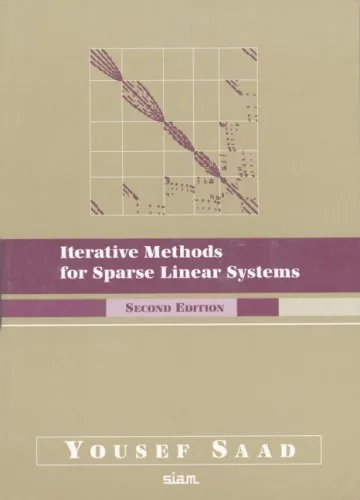
Iterative methods for sparse linear systems
Yousef Saad
English
Beginner
Mathematics
4.8 / 5
0 reviews
2003
Published
460
pages
204
views
Introduction to "Iterative Methods for Sparse Linear Systems" "Iterative Methods for Sparse Linear Systems" by Yousef Saad is a highly regarded resource for understanding and implementing numerical methods to solve large, sparse linear systems efficiently. This book combines m
Before you read
What will you get from this book?
Introduction to "Iterative Methods for Sparse Linear Systems"
"Iterative Methods for Sparse Linear Systems" by Yousef Saad is a highly regarded resource for understanding and implementing numerical methods to solve large, sparse linear systems efficiently. This book combines mathematical rigor with practical insights, making it an essential reference for researchers, students, and practitioners in computational science, engineering, and applied mathematics. With the increasing need for effective computational tools to address large-scale problems, this book equips readers with the foundational knowledge and advanced techniques to tackle complex systems efficiently.
Detailed Summary of the Book
The book provides a comprehensive exploration of iterative methods, with a focus on solving sparse linear systems often encountered in scientific and engineering applications. Starting with the mathematical foundations, the book introduces key concepts and frameworks required to understand the iterative processes. Topics like matrix theory, convergence properties, and preconditioning techniques are covered in depth. The text also delves into Krylov subspace methods, such as the Conjugate Gradient (CG) method, Generalized Minimal Residual (GMRES) method, and others like Bi-CGSTAB and QMR, explaining both their theoretical underpinnings and practical implementation.
One of the book's noteworthy aspects is its attention to practical challenges arising in real-world applications. For instance, sparse systems often require specific preconditioning strategies to ensure faster convergence. The author provides detailed guidance on various preconditioning techniques, such as incomplete factorization and approximate inverses, enabling readers to adapt these methods in practical scenarios. Furthermore, the book incorporates modern advances in computational frameworks, ensuring its relevance in today's increasingly complex numerical problems.
Each chapter includes illustrative examples, algorithmic descriptions, and discussions on computational considerations, which make the material accessible and directly applicable to varied contexts. The final chapters introduce advanced topics like parallel implementations and domain decomposition methods, bridging the gap between theory and practice in high-performance computing.
Key Takeaways
- A detailed understanding of iterative methods for solving large-scale sparse linear systems.
- Comprehensive coverage of Krylov subspace methods, including their derivation and practical application.
- Insights into preconditioning techniques and their impact on convergence and efficiency.
- Advanced discussions on parallel computing and modern computational strategies.
- A blend of theoretical concepts and practical considerations, making the book suitable for both academic and applied contexts.
Famous Quotes from the Book
"The iterative method provides a viable alternative to direct solvers, particularly when the matrix structure and size demand efficient computational solutions."
"Preconditioning is not just a trick for improving convergence; it is the art of transforming hard problems into easier ones."
Why This Book Matters
The significance of this book lies in its ability to address one of the core challenges in computational science — efficiently solving sparse linear systems at scale. Such systems are ubiquitous in fields like fluid dynamics, structural mechanics, machine learning, and quantum simulations. Iterative methods, as emphasized in the book, offer a practical solution for large-scale problems, where direct solvers might falter due to resource constraints. This makes the book invaluable for both theoreticians and practitioners.
Furthermore, the book's structured approach caters to a broad audience — from those seeking a deep dive into the mathematical theory behind iterative methods to those interested in implementing these methods in real-world scenarios. By bridging the gap between theoretical understanding and practical application, Yousef Saad has created a timeless resource that remains highly relevant in the era of advanced computing and data-driven science.
In conclusion, "Iterative Methods for Sparse Linear Systems" is more than a technical resource; it is a guide to mastering one of the most critical computational tools in modern science and engineering. Whether you are a student, researcher, or professional, this book will undoubtedly enrich your knowledge and empower you to solve complex problems efficiently.
Ask this book
Your question is answered in the context of this title and author. Each answer uses 2 points.
Sign in to ask the book assistant.
Reader reviews
0 reviews, 4.8 average out of 5
No reviews yet
If you have read this book, help the next reader with your experience.
Write a review
Sign in to publish a review.
Reader questions and answers
Ask a focused question and learn from the community.
Sign in to ask or answer a question.
No questions yet
Be the first to ask a clear, useful question.
What to read next
Related references that continue this learning path.

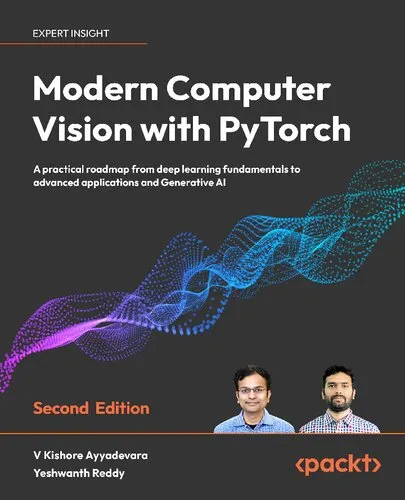
Modern Computer Vision with PyTorch: A Practical Roadmap From Deep Learning Fundamentals to Advanced Applications and Generative AI, 2nd Edition
V Kishore Ayyadevara,Yeshwanth Reddy
2023
View book