
Book guide and evaluation
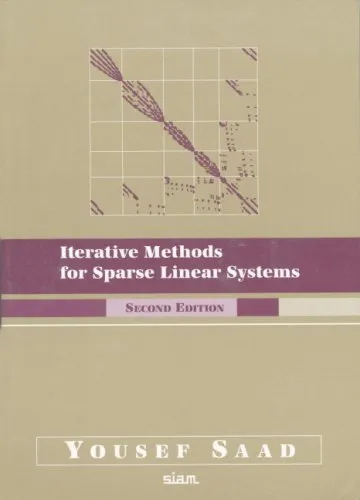
Iterative Methods for Sparse Linear Systems, Second Edition
Yousef Saad
English
Beginner
Mathematics
4.2 / 5
0 reviews
2003
Published
547
pages
189
views
Introduction to 'Iterative Methods for Sparse Linear Systems, Second Edition' "Iterative Methods for Sparse Linear Systems, Second Edition" is a comprehensive and authoritative text that delves deeply into the theory, algorithms, and practical applications of iterative met
Before you read
What will you get from this book?
Introduction to 'Iterative Methods for Sparse Linear Systems, Second Edition'
"Iterative Methods for Sparse Linear Systems, Second Edition" is a comprehensive and authoritative text that delves deeply into the theory, algorithms, and practical applications of iterative methods designed specifically for solving sparse linear systems. Building on the success of the first edition, this new release represents a significant update to accommodate advancements in the field, making it indispensable for researchers, students, and professionals alike.
Detailed Summary of the Book
The book begins with foundational concepts in linear algebra and sparse matrix structures, setting the stage for a detailed exploration of iterative methods. These methods are essential tools for solving large, sparse linear systems that commonly arise in scientific computing, engineering, and mathematical modeling. Unlike direct solvers, iterative methods focus on iterative refinement, making them particularly suited to modern computational applications where memory and processing efficiency are critical.
The text is carefully structured to cover key techniques such as Krylov subspace methods, conjugate gradient methods, GMRES (Generalized Minimal Residual) methods, and the use of preconditioning techniques to improve convergence rates. By emphasizing algorithmic details, numerical stability, and practical implementation, the book ensures that readers can translate theoretical knowledge into practical solutions.
The second edition also introduces updated material on advanced topics such as multigrid methods, domain decomposition techniques, and parallel computing strategies. These enhancements reflect the evolving landscape of high-performance computing and cater to the needs of computational scientists working on modern architectures.
Ample examples, exercises, and discussions reinforce the material, helping readers build a profound understanding of the subject matter. MATLAB code snippets and pseudocode are featured throughout the book to provide a hands-on learning experience. The result is not just a textbook but a rich resource for applied problem-solving and research.
Key Takeaways
- Comprehensive coverage of iterative methods, including Krylov subspace methods and preconditioning techniques, tailored for sparse systems.
- Current approaches to multigrid and domain decomposition methods, essential for large-scale computing problems.
- Detailed discussion on practical implementation aspects, ensuring the transition from theory to code is seamless.
- Algorithms and analysis presented with clarity, ensuring it is accessible to both beginners and advanced readers.
- Enhanced focus on parallel computing, reflecting the increasing importance of distributed systems and GPUs in computational science.
Famous Quotes from the Book
"The power of iterative methods lies in their ability to achieve solutions incrementally, focusing computational effort only where it is truly needed."
"Sparse systems require tailored methods, not just in theory but also in philosophy—each nonzero element carries critical information."
"Preconditioning is not just a technical detail; it is the art of reshaping a problem to make its solution not only feasible but elegant."
"Computing today means mastering parallelism, and iterative methods are some of the most natural algorithms to benefit from this paradigm shift."
Why This Book Matters
A hallmark feature of this book is its relevance to both academic and practical domains. Sparse systems are ubiquitous in today's scientific and engineering challenges, from fluid dynamics simulations to machine learning applications. The growing size and complexity of modern problems demand algorithms that scale efficiently in both memory and speed, and iterative methods form the backbone of these approaches.
The second edition of this book stands out as a definitive guide, not only for its depth but also for its clarity. It bridges the gap between mathematical theory and computational practice, offering a clear roadmap for implementing state-of-the-art algorithms on real-world problems. It is particularly important in the era of high-performance computing, where mastery of parallelism and advanced numerical techniques is essential.
Students, researchers, and professionals in computational sciences, applied mathematics, and engineering disciplines will benefit immensely from the structured and comprehensive content offered. The book's emphasis on algorithmic insights, supported by examples and hands-on tools, makes it timeless and transformative.
Ask this book
Your question is answered in the context of this title and author. Each answer uses 2 points.
Sign in to ask the book assistant.
Reader reviews
0 reviews, 4.2 average out of 5
No reviews yet
If you have read this book, help the next reader with your experience.
Write a review
Sign in to publish a review.
Reader questions and answers
Ask a focused question and learn from the community.
Sign in to ask or answer a question.
No questions yet
Be the first to ask a clear, useful question.
What to read next
Related references that continue this learning path.


Modern Computer Vision with PyTorch: A Practical Roadmap From Deep Learning Fundamentals to Advanced Applications and Generative AI, 2nd Edition
V Kishore Ayyadevara,Yeshwanth Reddy
2023
View book