
Book guide and evaluation
Iterative Methods for Large Linear Systems
David R. Kincaid,Linda J. Hayes
English
Beginner
Mathematics
4.4 / 5
0 reviews
1990
Published
327
pages
131
views
Introduction to "Iterative Methods for Large Linear Systems" Written by David R. Kincaid and Linda J. Hayes, "Iterative Methods for Large Linear Systems" is a highly acclaimed reference and textbook that delves deep into the numerical methods and algorithms essential for s
Before you read
What will you get from this book?
Introduction to "Iterative Methods for Large Linear Systems"
Written by David R. Kincaid and Linda J. Hayes, "Iterative Methods for Large Linear Systems" is a highly acclaimed reference and textbook that delves deep into the numerical methods and algorithms essential for solving large-scale linear systems in practical applications. This book serves as a distinguished guide for researchers, students, and professionals working in fields such as computational science, engineering, and applied mathematics.
Large-scale linear systems are pervasive in modern computational problems, ranging from engineering simulations to data science applications. Traditional direct solutions like Gaussian elimination are often computationally expensive and infeasible for such systems. To address these challenges, the authors introduce foundational yet powerful iterative methods that are efficient, require less memory, and are scalable to large problem sizes. With rich mathematical rigor and practical insights, this book strikes the perfect balance between theory and application, making it a must-have resource for anyone tackling complex numerical problems.
Detailed Summary of the Book
The book begins by laying a thorough mathematical groundwork that forms the basis for understanding iterative approaches to solve linear systems. The authors start with a discussion of linear algebra fundamentals, including matrix structures, eigenvalues, and condition numbers, which are critical in iterative algorithms. Key iterative methods discussed include the Jacobi method, Gauss-Seidel method, Successive Over-Relaxation (SOR), and Krylov subspace methods, such as the Conjugate Gradient method and GMRES.
One standout aspect of the book is its focus on real-world problems, providing numerous examples and case studies that show these iterative methods in action, such as solving finite element equations and systems derived from partial differential equations. Attention is given to convergence properties, performance optimization, and error analysis, ensuring readers understand how to implement these methods efficiently and with confidence.
The book also addresses preconditioning, a critical technique for enhancing the performance of iterative solvers. Preconditioning transforms a system to accelerate convergence, and the authors cover various types, including diagonal, incomplete factorization, and multigrid methods. The inclusion of exercises and computational experiments further solidify the reader's comprehension, equipping them with hands-on experience to apply in their own work.
Key Takeaways
- An accessible yet rigorous introduction to iterative methods for solving large and sparse linear systems.
- Extensive coverage of convergence theory, error analysis, and stability criteria.
- Practical guidance on algorithm implementation with attention to efficiency and scalability.
- Insight into challenging topics such as preconditioning and advanced methods like Krylov subspace techniques.
- A wide array of practical examples, problems, and exercises to bridge theory and application seamlessly.
Famous Quotes from the Book
"Efficient numerical methods are not only options but necessities in the ever-expanding horizon of large-scale computations."
"Iteration is not merely repetition but the refinement of solutions toward practicality and precision."
Why This Book Matters
This book matters because it fills a critical gap in the literature by addressing both theoretical and practical aspects of iterative methods for solving large-scale linear systems. At a time when computational problems are growing in complexity and size, traditional methods struggle to keep up. Iterative Methods for Large Linear Systems provides a roadmap for adopting modern, efficient techniques to overcome these challenges.
The relevance of the book extends across disciplines. Whether you are designing simulations in physics, solving optimization problems in machine learning, or working on massive data sets in engineering, the principles and techniques covered here have universal applicability. Moreover, the authors have ensured the material is both mathematically sound and accessible to readers from diverse technical backgrounds, making it an enduring resource in computational mathematics and scientific computing.
Ultimately, this book not only educates but also inspires. By equipping readers with the tools to surmount computational obstacles, Kincaid and Hayes empower them to push the boundaries of what's possible in applied mathematics and beyond.
Ask this book
Your question is answered in the context of this title and author. Each answer uses 2 points.
Sign in to ask the book assistant.
Reader reviews
0 reviews, 4.4 average out of 5
No reviews yet
If you have read this book, help the next reader with your experience.
Write a review
Sign in to publish a review.
Reader questions and answers
Ask a focused question and learn from the community.
Sign in to ask or answer a question.
No questions yet
Be the first to ask a clear, useful question.
What to read next
Related references that continue this learning path.

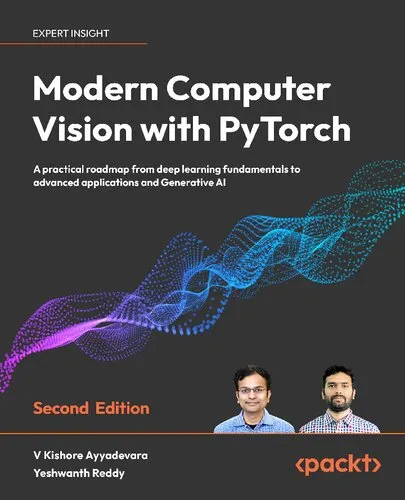
Modern Computer Vision with PyTorch: A Practical Roadmap From Deep Learning Fundamentals to Advanced Applications and Generative AI, 2nd Edition
V Kishore Ayyadevara,Yeshwanth Reddy
2023
View book