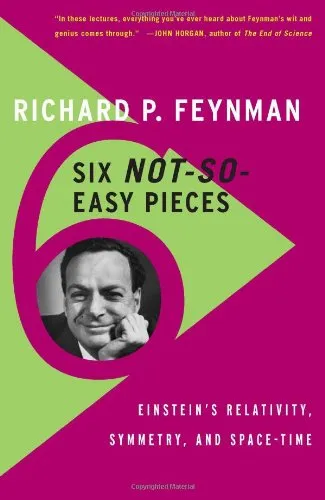
Six Not-So-Easy Pieces: Einstein's Relativity, Symmetry, and Space-Time
Richard P. Feynman,Robert B. Leighton,Matthew Sands
2011
View book
Book guide and evaluation
N. David Mermin
0 reviews
Published
pages
views
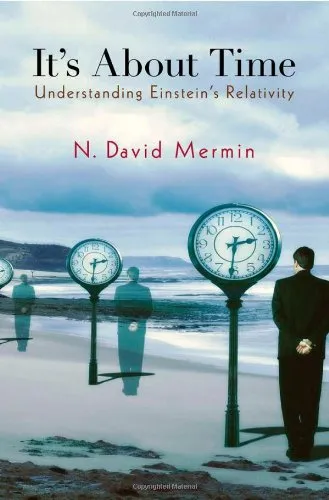
Introduction to "It's About Time: Understanding Einstein's Relativity" Time, space, and reality—these profound concepts have intrigued humanity for centuries. With "It's About Time: Understanding Einstein's Relativity," the brilliant physicist and author N. David Mermin of
Before you read
Time, space, and reality—these profound concepts have intrigued humanity for centuries. With "It's About Time: Understanding Einstein's Relativity," the brilliant physicist and author N. David Mermin offers a groundbreaking exploration of one of science's most compelling theories: Einstein's relativity. Both special and general relativity are often labeled as intricate and intimidating, but this remarkable book makes these theories accessible to anyone with an ordinary curiosity about the nature of our universe.
Written in an engaging and conversational style, this book meticulously breaks down the fundamentals of relativity without overwhelming the reader with advanced mathematics. Instead, it focuses on clear explanations, thought experiments, and conceptual clarity. Whether you're a student, a teacher, or an avid lover of scientific truths, "It's About Time" will guide you through the mysteries of spacetime with elegance and wit.
"It's About Time" takes readers on a transformative journey to understand Einstein's vision of the universe. The book begins by demystifying the concept of time—how we perceive it, measure it, and misunderstand it. It then delves into Einstein's revolutionary contributions, starting with special relativity, where the speed of light's constancy leads to counterintuitive phenomena like time dilation and length contraction.
Mermin emphasizes the symmetry and simplicity underlying these seemingly bizarre effects, illuminating how they arise from the basic assumptions of relativity. From synchronizing clocks to understanding the relativity of simultaneity, readers are drawn into how relativity reshapes our everyday notions of time and space.
Later chapters introduce general relativity, Einstein's broader theory that connects gravity to the curvature of spacetime. Mermin provides an insightful, non-technical explanation of how mass bends spacetime, leading to phenomena like gravitational time dilation and the bending of light. While maintaining his focus on conceptual understanding, he also addresses common misconceptions surrounding relativity and bridges the gap between intuition and Einstein's equations.
Here are some of the core insights readers will gain from "It's About Time":
Mermin's writing is filled with eloquent and thought-provoking lines that capture the essence of relativity. Here are some notable quotes:
"Time is not an absolute backdrop to the events of the universe; it is intertwined with space and shaped by motion."
"Relativity challenges not just how we calculate time and space, but how we perceive reality itself."
"Einstein’s genius lay not in telling us that time is strange, but in showing us how beautifully logical its strangeness is."
"It's About Time" is more than a scientific exploration—it's a doorway to wonder and understanding. Relativity has profoundly influenced physics, cosmology, and philosophy, changing how we think about the universe. This book matters because it makes a revolutionary theory comprehensible to non-scientists while retaining the beauty and rigor of Einstein's insights.
In an age where science often appears intimidating or irrelevant, Mermin reminds us of the joy found in intellectual discovery. Whether you're looking to deepen your knowledge, develop a new perspective on the world, or simply satisfy your intellectual curiosity, this book is an invaluable guide to Einstein's universe.
Your question is answered in the context of this title and author. Each answer uses 2 points.
0 reviews, 4.5 average out of 5
Sign in to publish a review.
Ask a focused question and learn from the community.
Related references that continue this learning path.
Richard P. Feynman,Robert B. Leighton,Matthew Sands