
Book guide and evaluation
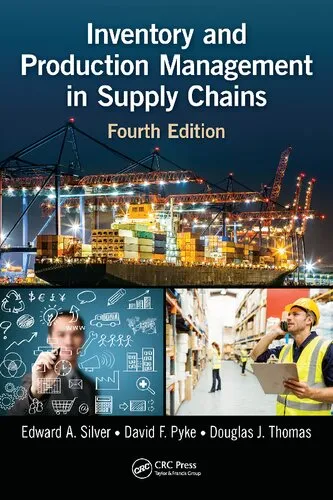
Inventory and Production Management in Supply Chains
Edward A. Silver,David F. Pyke,Douglas J. Thomas
English
Beginner
Economics
4.8 / 5
0 reviews
2016
Published
810
pages
225
views
Introduction to "Inventory and Production Management in Supply Chains" In the rapidly evolving world of supply chain management, efficiency and precision are more critical than ever. "Inventory and Production Management in Supply Chains", authored by Edward A. Silver
Before you read
What will you get from this book?
Introduction to "Inventory and Production Management in Supply Chains"
In the rapidly evolving world of supply chain management, efficiency and precision are more critical than ever. "Inventory and Production Management in Supply Chains", authored by Edward A. Silver, David F. Pyke, and Douglas J. Thomas, serves as a cornerstone for professionals, academics, and students seeking comprehensive insights into the field. This book provides a structured methodology for understanding and optimizing inventory and production systems, blending theoretical foundations with practical applications.
Through a rigorous exploration of inventory models, production planning techniques, and the integration of supply chain components, the book emphasizes the importance of data-driven decisions in addressing real-world challenges. By presenting complex concepts in a clear and methodical way, it equips readers with the tools needed to streamline operations and improve overall supply chain performance.
Summary of the Book
"Inventory and Production Management in Supply Chains" serves as a comprehensive guide to managing inventory systems and production processes within modern supply chains. The book begins by presenting the foundational principles of inventory control, covering topics such as demand forecasting, lot sizing, and cost structures. It dives deeper into inventory theories, introducing both deterministic and stochastic models that are widely applicable across industries.
As the book progresses, it moves into the realm of production management, exploring master production scheduling, material requirements planning (MRP), and capacity planning. Special emphasis is placed on the intersection of inventory and production, offering insights into their interplay and how decision-making in one area impacts the other. The authors also delve into advanced topics such as Just-In-Time (JIT) systems, Lean principles, supply chain coordination, and risk pooling.
A distinguishing feature of the book is its focus on the practical implementation of concepts. Through case studies, numerical examples, and thought-provoking exercises, it bridges the gap between theory and real-world application. Whether discussing multi-echelon inventory systems, dynamic lot-sizing techniques, or modern supply chain technologies, the authors maintain a consistent focus on the importance of integrating these tools into cohesive supply chain strategies.
Key Takeaways
- A structured approach to inventory management, encompassing deterministic and stochastic models.
- Comprehensive coverage of production management, including scheduling and capacity planning.
- Insights into the importance of aligning inventory and production for a competitive edge.
- Practical examples, exercises, and case studies to support learning and real-world application.
- Discussion of advanced topics such as Lean systems, Just-In-Time production, and supply chain risk management.
- Focus on the role of data and analytics in decision-making for supply chain optimization.
Famous Quotes from the Book
“Effective supply chain management begins with understanding the delicate balance between inventory and production.”
“An optimal inventory system maximizes customer satisfaction while minimizing holding and operational costs.”
“The key to successful production planning lies in synchronizing all aspects of the supply chain—from raw material procurement to finished goods delivery.”
Why This Book Matters
In today's complex and interconnected supply chains, the ability to efficiently manage inventory and production processes is paramount. "Inventory and Production Management in Supply Chains" provides an unparalleled framework for understanding these critical functions. It goes beyond traditional theories of inventory control or production management and emphasizes their integration within a broader supply chain context.
The book is particularly valuable for its practical orientation. Solutions are not merely academic but grounded in real-world applications that readers can implement within their own organizations. With global supply chains becoming increasingly dynamic and unpredictable, the strategies outlined in this book offer organizations a way to navigate uncertainty while maintaining competitive advantages.
Moreover, as businesses become increasingly reliant on data and advanced analytics, the text underscores their role in making informed decisions. By focusing on the intersection of data science and supply chain management, it provides a forward-looking perspective that is vital for professionals navigating a technology-driven world.
Ultimately, "Inventory and Production Management in Supply Chains" matters because it equips readers with the knowledge they need to drive efficiency, enhance customer satisfaction, and create resilient and sustainable supply chain systems. For anyone involved in supply chain management, whether as a practitioner or a scholar, this book is an indispensable resource and guide.
Ask this book
Your question is answered in the context of this title and author. Each answer uses 2 points.
Sign in to ask the book assistant.
Reader reviews
0 reviews, 4.8 average out of 5
No reviews yet
If you have read this book, help the next reader with your experience.
Write a review
Sign in to publish a review.
Reader questions and answers
Ask a focused question and learn from the community.
Sign in to ask or answer a question.
No questions yet
Be the first to ask a clear, useful question.
What to read next
Related references that continue this learning path.

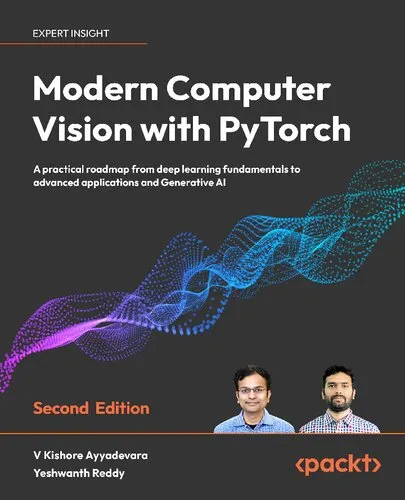
Modern Computer Vision with PyTorch: A Practical Roadmap From Deep Learning Fundamentals to Advanced Applications and Generative AI, 2nd Edition
V Kishore Ayyadevara,Yeshwanth Reddy
2023
View book