
Book guide and evaluation
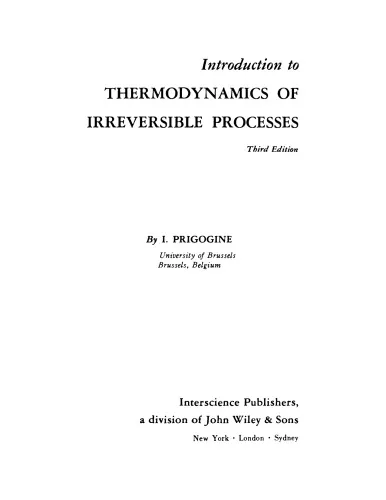
Introduction to thermodynamics of irreversible processes
I Prigogine
English
Beginner
Thermodynamics
4.5 / 5
0 reviews
1955
Published
161
pages
478
views
Introduction to Thermodynamics of Irreversible Processes In the realm of modern science, the study of thermodynamics transcends the bounds of traditional theory and understanding through the exploration of irreversible processes. This book, authored by Ilya Prigogine, delv
Before you read
What will you get from this book?
Introduction to Thermodynamics of Irreversible Processes
In the realm of modern science, the study of thermodynamics transcends the bounds of traditional theory and understanding through the exploration of irreversible processes. This book, authored by Ilya Prigogine, delves into the complex dynamics and evolution of systems that are far from equilibrium, offering an extensive perspective on how these processes influence the natural world and technological advancements.
Detailed Summary of the Book
This seminal work marks a significant departure from classical thermodynamics, which primarily focuses on systems in equilibrium. Instead, 'Introduction to Thermodynamics of Irreversible Processes' emphasizes the behavior and properties of systems as they undergo changes that are not necessarily reversible. Throughout the book, Prigogine introduces key concepts such as entropy production, stability of states, and the role of time in defining the direction of processes. The text meticulously constructs a framework for understanding how irreversible processes drive myriad phenomena in chemistry, physics, and biology. Through a mathematical treatment that remains accessible and insightful, Prigogine elaborates on how these principles can explain the emergence of order out of chaos, challenging the conventional view of entropy as merely a path to disorder.
Key Takeaways
- The book introduces the concept of entropy production as a means to quantify dissipative processes, forming the cornerstone for understanding how systems evolve.
- Unlike equilibrium thermodynamics, this work reveals the significance of time's arrow in steering processes towards irreversibility, thereby linking thermodynamics to arrow of time.
- Prigogine offers insights into how ordered structures and patterns can arise spontaneously through self-organization in far-from-equilibrium conditions, a principle that applies across disciplines and scales.
- The interdisciplinary approach of the book fosters a deeper appreciation of the unifying principles in science, extending the legacy of thermodynamics beyond its traditional boundaries.
Famous Quotes from the Book
"The arrow of time is the manifestation of non-equilibrium processes and the organization they create."
"The study of irreversible processes is the study of life in its continual quest for balance."
Why This Book Matters
The importance of 'Introduction to Thermodynamics of Irreversible Processes' lies in its pioneering approach to understanding nature's complexity through the lens of irreversible processes. Prigogine's work bridges the gap between classical and modern views, offering a comprehensive narrative on why processes in nature proceed as they do. It speaks to scientists and students alike across various fields, offering fundamental insights that drive current research in non-equilibrium thermodynamics, complex systems, and beyond.
The book not only inspires scientific inquiry but also fuels philosophical discussions on the nature of time and order, challenging the deterministic world view. Through this work, Prigogine has cemented his legacy in highlighting the intricate dance between chaos and order, and the creative potential embedded in complexity.
Ask this book
Your question is answered in the context of this title and author. Each answer uses 2 points.
Sign in to ask the book assistant.
Reader reviews
0 reviews, 4.5 average out of 5
No reviews yet
If you have read this book, help the next reader with your experience.
Write a review
Sign in to publish a review.
Reader questions and answers
Ask a focused question and learn from the community.
Sign in to ask or answer a question.
No questions yet
Be the first to ask a clear, useful question.
What to read next
Related references that continue this learning path.

Simulation with Entropy Thermodynamics: Understanding Matter and Systems with Bondgraphs
Prof. Jean Thoma,Dr. Gianni Mocellin (auth.)
2006
View book

Understanding Energy: Energy, Entropy and Thermodynamics for Everyman
R. Stephen Berry
1991
View book