
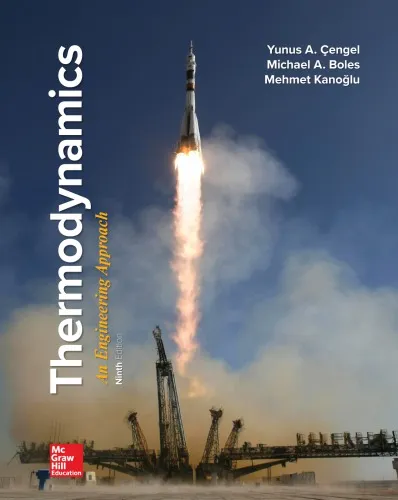
THERMODYNAMICS: AN ENGINEERING APPROACH, NINTH EDITION
Çengel,Yunus A. Boles,Michael A. Kanoğlu,Mehmet
2019
View book
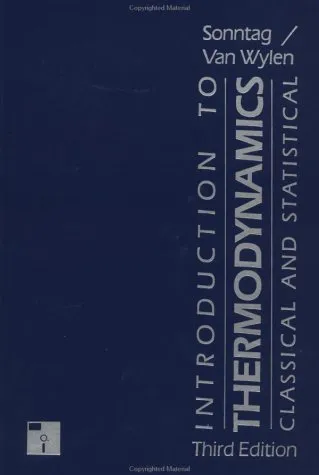
Book guide and evaluation
Richard E. Sonntag,Gordon J. Van Wylen
0 reviews
Published
pages
views
Introduction to Thermodynamics, Classical and Statistical Welcome to an insightful exploration of thermodynamics, a field that speaks to the very heart of physics and engineering. This book, "Introduction to Thermodynamics, Classical and Statistical," co-authored by Richard
Before you read
Welcome to an insightful exploration of thermodynamics, a field that speaks to the very heart of physics and engineering. This book, "Introduction to Thermodynamics, Classical and Statistical," co-authored by Richard E. Sonntag and Gordon J. Van Wylen, serves as an indispensable guide for students and professionals seeking a comprehensive understanding of both classical and statistical thermodynamics.
Thermodynamics is the science of energy and entropy, exploring the principles that govern the physical universe. This text is designed to provide a balanced presentation of the classical and statistical methods in thermodynamics. The classical part delves into the familiar principles of energy, entropy, equilibrium, and the laws of thermodynamics, laying a solid foundation for readers. The statistical approach, on the other hand, offers a microscopic understanding of matter and energy through probability theory and statistical mechanics. This juxtaposition encourages a deeper understanding of how macroscopic phenomena emerge from microscopic laws.
The book is strategically divided to cover key topics such as the laws of thermodynamics, properties of pure substances, energy analysis, entropy, and applications to both closed and open systems. As readers progress, they will gain insights into advanced topics like thermodynamic relations, chemical reactions, and phase equilibria.
"Energy can be neither created nor destroyed, but it can be transformed from one form to another."
"The entropy of the universe tends to increase, signifying the directionality inherent in all processes."
Understanding thermodynamics is crucial for engineers, scientists, and anyone involved in the physical sciences. This book matters because it provides clear and methodical insights into fundamental concepts that shape our understanding of the natural world. By marrying classical theories with statistical mechanics, it presents a holistic view that is critical for advanced study and practical applications in fields such as engineering, chemistry, physics, and environmental science.
Moreover, the writing style is approachable, making complex ideas accessible to a wide audience without sacrificing depth or rigor. Each chapter is replete with examples, exercises, and real-world applications, ensuring that readers not only grasp theoretical concepts but also understand their practical implications.
Your question is answered in the context of this title and author. Each answer uses 2 points.
0 reviews, 4.5 average out of 5
Sign in to publish a review.
Ask a focused question and learn from the community.
Related references that continue this learning path.
Çengel,Yunus A. Boles,Michael A. Kanoğlu,Mehmet
Vera, Juan H.;Wilczek-Vera, Grazyna
Antonio Saggion,Rossella Faraldo,Matteo Pierno