

Engineering thermofluids: thermodynamics, fluid mechanics, and heat transfer
Mahmoud Massoud
2005
View book
Book guide and evaluation
Michael J. Moran,Howard N. Shapiro,Bruce R. Munson,David P. DeWitt
0 reviews
Published
pages
views
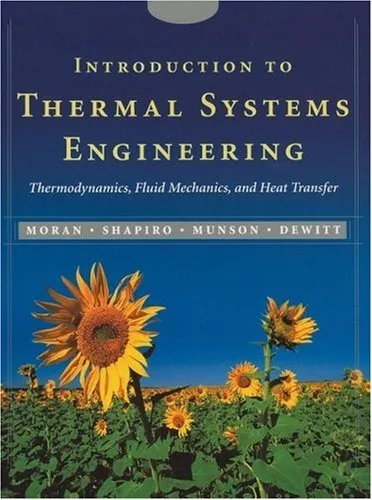
Introduction to Thermal Systems Engineering "Introduction to Thermal Systems Engineering: Thermodynamics, Fluid Mechanics, and Heat Transfer" is a comprehensive guide aimed at equipping readers with foundational and advanced knowledge in the key domains of thermal
Before you read
"Introduction to Thermal Systems Engineering: Thermodynamics, Fluid Mechanics, and Heat Transfer" is a comprehensive guide aimed at equipping readers with foundational and advanced knowledge in the key domains of thermal systems engineering. Authored by Michael J. Moran, Howard N. Shapiro, Bruce R. Munson, and David P. DeWitt, this book serves as an essential resource for both students and professionals eager to deepen their understanding of the science of thermodynamics, fluid mechanics, and heat transfer.
The book takes a holistic approach to presenting thermal systems engineering by integrating three fundamental topics: thermodynamics, fluid mechanics, and heat transfer. This integration is crucial for a cohesive understanding of how different energy systems operate, making it more accessible for learners who wish to master the art and science of designing more efficient engineering systems.
Beginning with core principles of thermodynamics, the authors meticulously unravel the science of energy, elucidating fundamental concepts such as energy conservation, the laws of thermodynamics, and various cycles used in energy conversion technology. The exploration of these primary principles is routed into practical applications that prepare readers to tackle real-world engineering challenges.
Moving forward, the book delves into fluid mechanics. Here, readers find a strategic discourse on fluid properties, fluid statics, and dynamics. Through this section, the authors aim to bridge the analytical skills required for examining forces and energy in liquids and gases with practical engineering needs.
Concluding with heat transfer, the text approaches conduction, convection, and radiation with scientific rigor, relatable examples, and problem-solving exercises. This section is instrumental for students and engineers who work with thermal systems, as it provides necessary tools for predicting temperatures, energy transfers, and system performances with accuracy.
"Understanding the language of energy and engineering opens new doors to how we envision and interact with the world around us."
"Engineering is not only about technical knowledge but also about applying an integrated approach to solve complex thermal phenomena."
As the demand for sustainable energy sources and efficient thermal systems technology continues to rise, the importance of mastering the principles covered in this book becomes ever more pronounced. "Introduction to Thermal Systems Engineering" is a pivotal educational resource that empowers engineering students, educators, and practicing engineers by providing a detailed, unified foundation that encompasses key thermal science disciplines. Its relevance extends beyond academia, as the knowledge acquired from this text can be directly implemented in industries striving for innovation and sustainability. The book’s structured pedagogy, combined with practical perspectives, makes it a timeless reference for future technological advancements and solutions in thermal systems engineering.
Your question is answered in the context of this title and author. Each answer uses 2 points.
0 reviews, 4.5 average out of 5
Sign in to publish a review.
Ask a focused question and learn from the community.
Related references that continue this learning path.
Mahmoud Massoud

Stephen Blundell,Katherine Blundell

Hans U. Fuchs (auth.)