
Book guide and evaluation
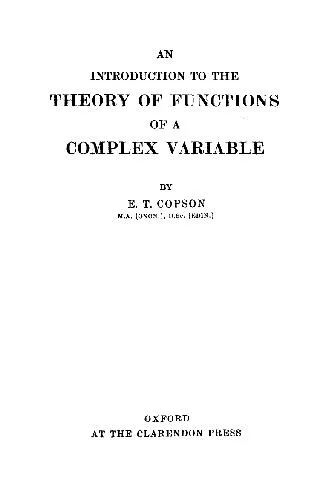
Introduction to the Theory of Functions of a Complex Variable
E.T. Copson
English
Beginner
Mathematical Analysis
4.5 / 5
0 reviews
1970
Published
455
pages
498
views
Introduction Welcome to 'Introduction to the Theory of Functions of a Complex Variable', a comprehensive guide crafted to impart a solid understanding of complex analysis. This book aims to bridge the gap between theory and application, offering scholarly depth in the field of
Before you read
What will you get from this book?
Introduction
Welcome to 'Introduction to the Theory of Functions of a Complex Variable', a comprehensive guide crafted to impart a solid understanding of complex analysis. This book aims to bridge the gap between theory and application, offering scholarly depth in the field of complex variables - an instrumental domain in both pure and applied mathematics.
Detailed Summary
Rich in mathematical rigor, the book delves into the fundamental elements of complex variables, establishing a firm foundation in the subject. It introduces readers to the construction and interpretation of functions of a complex variable, exploring the intricacies of analytic functions, singularities, and residues. The book provides an in-depth examination of Cauchy's Theorem and Argand diagrams, elucidating their critical roles within complex analysis.
The text systematically unravels the theories and applications of contour integration and series expansions, making it a quintessential resource for students and researchers alike. Readers will traverse the mathematical landscape of conformal mapping, examining its practical and theoretical applications. With step-by-step explications and illustrative examples, this book simplifies the complexities of these abstract notions, ensuring an accessible learning journey for aspiring mathematicians.
Key Takeaways
- Comprehensive understanding of complex functions and their differentiability.
- Detailed insight into Cauchy's integral theorem and its implications.
- Mastery of techniques for evaluating contour integrals and infinite series.
- Proficiency in applying the theory of residues to various mathematical and engineering problems.
- Fluency in conformal mapping and its utilitarian values in varied contexts.
Famous Quotes from the Book
"The study of functions of a complex variable often presents the first occasion for students to appreciate mathematics as a profound and unified discipline."
"Understanding the singular points and the zeros of analytic functions paves the path to the core of complex analysis, unlocking the subject's nuanced beauty."
Why This Book Matters
Esteemed for its clarity and precision, 'Introduction to the Theory of Functions of a Complex Variable' stands as a pivotal text for those delving into the rich field of complex analysis. The book's enduring popularity owes much to its ability to demystify complex mathematical concepts, rendering them accessible to learners at various stages in their mathematical journey.
By methodically covering the spectrum of complex analysis, the book equips readers not only with knowledge but also with a discerning mathematical mindset, fostering analytical skills indispensable in mathematical research and applications. Whether your goal is to navigate the theoretical landscapes of mathematics or to apply these concepts in scientific pursuits, this book offers invaluable insights and methodologies that transcend the classroom.
Ask this book
Your question is answered in the context of this title and author. Each answer uses 2 points.
Sign in to ask the book assistant.
Reader reviews
0 reviews, 4.5 average out of 5
No reviews yet
If you have read this book, help the next reader with your experience.
Write a review
Sign in to publish a review.
Reader questions and answers
Ask a focused question and learn from the community.
Sign in to ask or answer a question.
No questions yet
Be the first to ask a clear, useful question.
What to read next
Related references that continue this learning path.

Functional Equations and Inequalities: Solutions and Stability Results
K Ravi;B V Senthil Kumar;John Michael Rassias
2017
View book
Introduction to Banach algebras, operators, and harmonic analysis
H. Garth Dales,Pietro Aiena,Jörg Eschmeier,Kjeld Laursen,George A. Willis
2003
View book