
Book guide and evaluation
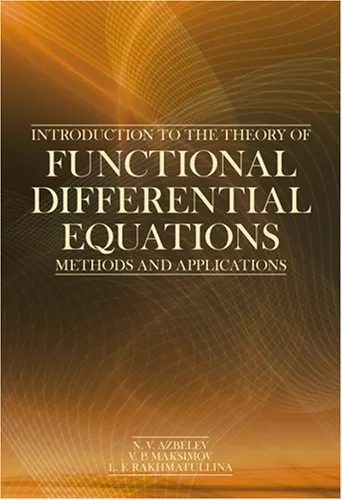
Introduction to the theory of functional differential equations
N. V. Azbelev, V. P. Maksimov,andL. F. Rakhmatullina
English
Beginner
Mathematical Analysis
4.5 / 5
0 reviews
2007
Published
325
pages
502
views
Introduction to the Theory of Functional Differential Equations Functional differential equations (FDEs) play a critical role in modeling dynamic systems where the evolution of the state depends not only on the current state but also on its history. These equations appear wi
Before you read
What will you get from this book?
Introduction to the Theory of Functional Differential Equations
Functional differential equations (FDEs) play a critical role in modeling dynamic systems where the evolution of the state depends not only on the current state but also on its history. These equations appear widely in engineering, biology, economics, and physics, making their study indispensable for advancements in multiple domains. "Introduction to the Theory of Functional Differential Equations" is a foundational text written by N. V. Azbelev, V. P. Maksimov, and L. F. Rakhmatullina. It aims to provide both a theoretical foundation and practical tools to analyze and solve FDEs effectively.
Detailed Summary
The book is structured systematically to introduce readers to the theoretical fundamentals and applied aspects of functional differential equations. The authors begin with an in-depth discussion of differential equations where delays or deviations are involved. The concept of "functional dependency" is thoroughly explored, emphasizing how present behaviors influence future outcomes through historical data.
The initial chapters cover the basic definitions, mathematical preliminaries, and a detailed examination of the classification of FDEs. Readers are introduced to the distinctions between retardation, neutral type, and mixed-type functional differential equations. The authors ensure that these concepts are accessible by building on classical differential equations and gradually expanding into the functional domain.
Following this, the book delves into the existence and uniqueness problems, stability theories, and various solution techniques. A significant portion of the text is dedicated to the qualitative analysis of solutions, drawing parallels with ordinary differential equations but also addressing the unique challenges posed by functional dependencies. Another key aspect of the book is its attention to abstract spaces where FDEs reside, such as Banach and Hilbert spaces, offering tools for tackling operator equations.
One of the standout features of the book is its focus on practical examples, applications, and illustrative problems. Whether it is the modeling of biological systems, engineering applications, or control theory, the authors establish the relevance of FDEs in real-world contexts. Each chapter includes exercises that encourage active engagement, thereby solidifying the concepts discussed.
Key Takeaways
- Comprehensive introduction to the theory and application of functional differential equations.
- Clarity in explaining the concepts of delay, deviance, and dependency in dynamic systems.
- Robust discussion of stability theories, solution existence, and uniqueness criteria.
- Practical examples and exercises to develop problem-solving skills in FDEs.
- Insight into advanced topics, such as operator equations and abstract function spaces.
Famous Quotes from the Book
“The present is not an isolated moment; it is the culmination of the past and the foundation of a future dependent on its history.”
“Functional differential equations serve as a bridge between the traditional and the contemporary, linking the static past to the dynamic present.”
Why This Book Matters
This book holds immense importance for both students and researchers in mathematics, physics, and applied sciences. At its core, it offers a clear and structured way to approach FDEs, which are often regarded as complex. By combining theoretical rigor with practical examples, the authors empower readers to model, analyze, and solve dynamic real-world problems influenced by historical data.
Moreover, the book bridges the gap between classical differential equations and modern functional analysis, offering a fresh perspective for those already familiar with basic differential equations. It serves as not only a didactic tool but also as a reference for advanced research in mathematical modeling. Functional differential equations are becoming more relevant in today’s interconnected and dynamic world, underlining the enduring relevance of this scholarly work.
Ask this book
Your question is answered in the context of this title and author. Each answer uses 2 points.
Sign in to ask the book assistant.
Reader reviews
0 reviews, 4.5 average out of 5
No reviews yet
If you have read this book, help the next reader with your experience.
Write a review
Sign in to publish a review.
Reader questions and answers
Ask a focused question and learn from the community.
Sign in to ask or answer a question.
No questions yet
Be the first to ask a clear, useful question.
What to read next
Related references that continue this learning path.


Frontiers in Functional Equations and Analytic Inequalities
George A. Anastassiou,John Michael Rassias
2019
View book
Functional Equations and Inequalities: Solutions and Stability Results
K Ravi;B V Senthil Kumar;John Michael Rassias
2017
View book