

Book guide and evaluation
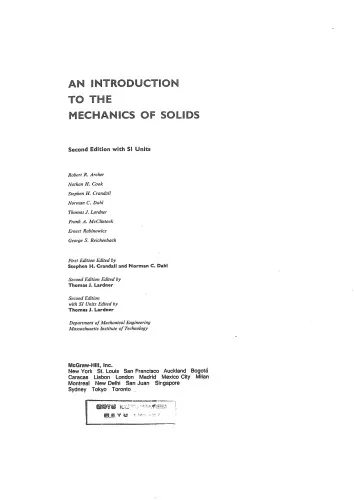
Introduction to the Mechanics of Solids: In S.I.Units
Stephen H. Crandall,Norman C. Dahl
English
Beginner
Classical Mechanics
4.3 / 5
0 reviews
1978
Published
640
pages
253
views
Introduction to the Mechanics of Solids: In S.I. Units The field of mechanics of solids is fundamental to the study of engineering, as it forms the cornerstone for understanding structures, materials, and applied forces. The book Introduction to the Mechanics of Solids:
Before you read
What will you get from this book?
Introduction to the Mechanics of Solids: In S.I. Units
The field of mechanics of solids is fundamental to the study of engineering, as it forms the cornerstone for understanding structures, materials, and applied forces. The book Introduction to the Mechanics of Solids: In S.I. Units, authored by Stephen H. Crandall and Norman C. Dahl, offers a comprehensive treatment of this subject. It is a meticulously designed reference for students, educators, and engineers seeking a blend of theoretical depth and practical relevance in solid mechanics. With its seamless integration of physical concepts, mathematical rigor, and real-world applications, this book serves as an indispensable guide that has stood the test of time in engineering education.
Detailed Summary of the Book
The book delicately balances theory and application, making it equally suitable for beginners and advanced learners. It starts with the fundamentals of static equilibrium and stress analysis, laying down the groundwork for deeper exploration. The authors build upon these concepts with discussions on strain, material properties, and constitutive relationships. The transition from basic principles to more advanced topics such as energy methods, torsion, bending, and buckling is gradual yet precise.
The S.I. units system is employed throughout the book, enabling global accessibility and adherence to international standards. Practical examples and solved problems provide clarity, while exercises encourage readers to apply their learning to solve engineering challenges. Additionally, the book highlights the importance of geometry and mathematical relationships in analyzing mechanical behavior. By focusing on both elastic and inelastic responses of materials, the authors emphasize the need for a complete understanding of structural behaviors under different conditions.
Key Takeaways
- A thorough understanding of statics and stress-strain relationships essential for mechanical analysis.
- Step-by-step derivations of key formulas, ensuring comprehension at the fundamental level.
- Comprehensive coverage of topics such as torsion, bending, deflection, and energy principles in solid mechanics.
- A problem-solving approach that bridges theoretical principles and engineering applications.
- Extensive emphasis on graphical and physical interpretations of mechanical behavior for effective learning.
Famous Quotes from the Book
"The study of solid mechanics is not merely about calculations; it is about understanding the underlying principles that govern physical phenomena."
"A sound grasp of equilibrium and material responses paves the way for solving even the most complex engineering problems."
"The importance of simplifying assumptions in mechanics cannot be overstated—they bridge the gap between mathematical models and real-world applications."
Why This Book Matters
This book is significant for various reasons that make it a standout reference in the field of engineering mechanics. Firstly, it integrates physical intuition with mathematical formulations, setting the tone for readers to approach problems analytically and creatively. Its modern treatment of solid mechanics, with a focus on S.I. units, makes it relevant to a global audience, aligning with contemporary measurement practices.
Secondly, it bridges the gap between basic mechanics and structural engineering, preparing readers for advanced topics in civil, mechanical, and aerospace engineering. Students and professionals alike benefit from its cohesive structure that connects the laws of physics to real-world applications. The comprehensive coverage and variety of solved examples make it an effective self-study resource as well as an ideal classroom textbook.
Lastly, the enduring legacy of this book rests not only on its technical content but also on its ability to invoke curiosity and inspire confidence in solving mechanical problems. Its timeless lessons in mechanics of solids continue to educate and empower engineers in designing safer, more efficient structures and materials.
Conclusion
This book remains a cornerstone for learning the mechanics of solids, catering to the needs of both theoretical enthusiasts and practical problem-solvers. With a clear focus on fundamentals, precise engineering applications, and global relevance due to its use of S.I. units, Introduction to the Mechanics of Solids is an essential read for anyone looking to deepen their understanding of this crucial field in engineering.
Ask this book
Your question is answered in the context of this title and author. Each answer uses 2 points.
Sign in to ask the book assistant.
Reader reviews
0 reviews, 4.3 average out of 5
No reviews yet
If you have read this book, help the next reader with your experience.
Write a review
Sign in to publish a review.
Reader questions and answers
Ask a focused question and learn from the community.
Sign in to ask or answer a question.
No questions yet
Be the first to ask a clear, useful question.
What to read next
Related references that continue this learning path.



Modern Computer Vision with PyTorch: A Practical Roadmap From Deep Learning Fundamentals to Advanced Applications and Generative AI, 2nd Edition
V Kishore Ayyadevara,Yeshwanth Reddy
2023
View book