
Book guide and evaluation
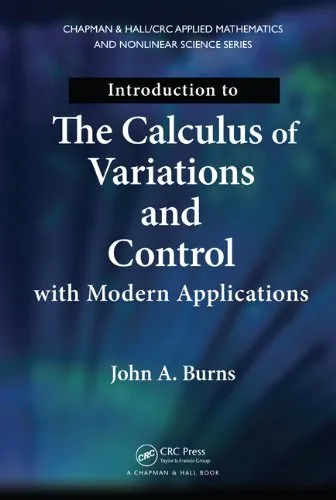
Introduction to the Calculus of Variations and Control with Modern Applications
John A. Burns
English
Beginner
Mathematics
4.6 / 5
0 reviews
2013
Published
564
pages
255
views
Introduction to the Calculus of Variations and Control with Modern Applications Welcome to "Introduction to the Calculus of Variations and Control with Modern Applications", a comprehensive exploration of classical and modern methods in optimization, functional analysis, and
Before you read
What will you get from this book?
Introduction to the Calculus of Variations and Control with Modern Applications
Welcome to "Introduction to the Calculus of Variations and Control with Modern Applications", a comprehensive exploration of classical and modern methods in optimization, functional analysis, and control theory. This book is dedicated to providing students, researchers, and professionals with a unified understanding of the foundational principles and advanced concepts of calculus of variations and optimization theory as applied to real-world scenarios in engineering, science, and beyond.
The field of calculus of variations and control theory is pivotal in modern science and engineering, offering powerful tools for the study of diverse problems ranging from optimal paths in robotics to energy minimization in mechanical systems. The book provides a detailed yet accessible introduction to these topics, integrating historical perspectives with hands-on applications to help readers bridge theory and practice effectively.
Detailed Summary of the Book
The book begins by presenting the historical origins of the calculus of variations, tracing its development from the seminal works of Euler, Lagrange, and others who laid its mathematical foundation. It moves seamlessly into modern perspectives, emphasizing applications across multidisciplinary fields.
In the initial chapters, the fundamental principles of the calculus of variations are introduced, including topics such as the Euler-Lagrange equations, boundary conditions, and extremals. These principles are carefully derived and explained, focusing on real-world problems like shortest paths, geodesics, and applications in physics.
The subsequent sections transition into control theory, beginning with a review of linear and nonlinear control systems. Here, the book explores Pontryagin's Maximum Principle, dynamic programming, and Hamilton-Jacobi-Bellman equations, equipping readers with robust tools to address problems in optimal control.
Throughout the text, emphasis is placed on modern applications, including areas such as robotics, aerodynamics, signal processing, and economics. Numerous worked examples, illustrations, and exercises are provided, giving readers the opportunity to apply theoretical knowledge to concrete problems. The inclusion of MATLAB-based examples and numerical solutions further enhances the practicality of the material.
The book concludes with advanced topics, such as inverse problems, calculus on manifolds, and applications in modern machine learning and data science frameworks. This integration highlights the relevance of calculus of variations and control theory in today’s data-driven world.
Key Takeaways
- Understand the historical and mathematical foundations of the calculus of variations and control theory.
- Learn practical problem-solving techniques using Euler-Lagrange equations, Pontryagin’s Maximum Principle, and Hamilton-Jacobi methods.
- Explore diverse real-world applications in engineering, physics, economics, and machine learning.
- Gain hands-on experience with MATLAB and numerical methods for solving optimization and control problems.
- Discover cutting-edge topics, including inverse problems and machine-learning-informed approaches to control.
Famous Quotes from the Book
"The beauty of the calculus of variations lies not only in its mathematical elegance but also in its ability to unite theory and application, offering deep insights and practical solutions to complex problems."
"Control theory exemplifies the human drive to not only understand systems but to direct their behavior toward achievable and optimal goals."
Why This Book Matters
This book is a pivotal resource for anyone looking to explore the fundamental principles and cutting-edge applications of calculus of variations and control theory. Its detailed explanations, backed by numerical examples and applications, make it a go-to reference for both students and professionals.
In an era where optimization and control are central to fields as diverse as artificial intelligence, quantum computing, and sustainable energy, understanding these principles is no longer optional—it is essential. This book bridges the gap between theory and application, equipping readers with the skills and insights necessary to tackle some of the most pressing challenges of our time.
Whether you are a mathematician, scientist, or engineer, this text will serve as your guide to the rich world of optimization and control.
Ask this book
Your question is answered in the context of this title and author. Each answer uses 2 points.
Sign in to ask the book assistant.
Reader reviews
0 reviews, 4.6 average out of 5
No reviews yet
If you have read this book, help the next reader with your experience.
Write a review
Sign in to publish a review.
Reader questions and answers
Ask a focused question and learn from the community.
Sign in to ask or answer a question.
No questions yet
Be the first to ask a clear, useful question.
What to read next
Related references that continue this learning path.


Modern Computer Vision with PyTorch: A Practical Roadmap From Deep Learning Fundamentals to Advanced Applications and Generative AI, 2nd Edition
V Kishore Ayyadevara,Yeshwanth Reddy
2023
View book