
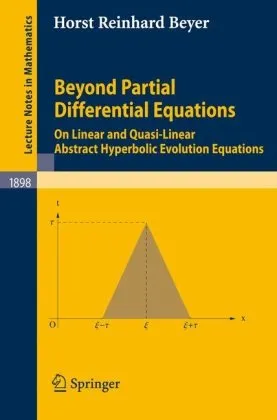
Beyond Partial Differential Equations: On Linear and Quasi-Linear Abstract Hyperbolic Evolution Equations
Horst Reinhard Beyer (auth.)
2007
View book
Book guide and evaluation
Böhm-Vitense E.
0 reviews
Published
pages
views
Introduction to Stellar Astrophysics, Volume 3: Stellar Structure and Evolution Written by Böhm-Vitense E., Introduction to Stellar Astrophysics, Volume 3: Stellar Structure and Evolution stands as a cornerstone work in the field of astrophysics. This book meticulo
Before you read
Written by Böhm-Vitense E., Introduction to Stellar Astrophysics, Volume 3: Stellar Structure and Evolution stands as a cornerstone work in the field of astrophysics. This book meticulously explores the fundamental principles shaping the physical and evolutionary properties of stars. Designed for advanced undergraduate and graduate students, as well as professionals in astrophysics, this volume brings clarity to the intricate mechanisms governing stellar interiors and their lifecycle. With a strong emphasis on the integration of theory and observation, it serves as a guide to grasping the physics of stars in the broader context of galactic evolution.
Volume 3 of the Introduction to Stellar Astrophysics series delves deeply into the structure and evolution of stars, building upon foundational principles introduced in the earlier volumes. The book meticulously unravels the inner workings of stars, focusing on topics such as hydrostatic equilibrium, nuclear fusion processes, opacity, and energy transport within stellar interiors.
A distinguishing feature of this volume is its detailed account of the processes that enable stars to exist in equilibrium over billions of years and the dramatic shifts that occur during their different evolutionary stages. From the formation of protostars in molecular clouds to their eventual transition into white dwarfs, neutron stars, or black holes, every stage is covered with precision.
Additionally, the book examines observational evidence, bridging robust theoretical models with empirical data collected through spectroscopy, photometry, and space-based missions. Emphasis is placed on understanding stellar populations, luminosity classification, and how these attributes feed into the overall understanding of the universe’s structure.
“The study of stars is not merely an exploration of distant entities; it is a quest to understand the fundamental workings of nature, from the smallest subatomic particles to the largest structures in the cosmos.”
“Stellar evolution is the story of change, governed by unyielding physical laws, revealing the incredible variety of forms that stars assume in their lifetimes.”
“Observing the millions of stars scattered across the sky allows us to trace not just their own histories but the history of our universe as a whole.”
Introduction to Stellar Astrophysics, Volume 3 occupies a pivotal role in our understanding of astrophysics. By focusing on the structural elements and evolutionary trajectories of stars, the book encapsulates a core aspect of modern astronomy. Its comprehensive nature ensures that readers not only grasp the physics behind stellar processes but also see their integration into galactic and cosmological scales.
The insights provided in this book are not solely academic. They have profound implications for understanding broader cosmic phenomena, from the distribution of elements in the universe to the dynamics of star-forming regions within galaxies. Aspiring astrophysicists, researchers, and educators will all find valuable knowledge and inspiration within its pages, making it an essential addition to any scientific library.
Furthermore, by linking theoretical underpinnings with observational data, this book equips readers with the tools to question, explore, and contribute to one of humanity’s oldest curiosities: the nature of stars and their role in the grand scheme of the universe.
Your question is answered in the context of this title and author. Each answer uses 2 points.
0 reviews, 4.6 average out of 5
Sign in to publish a review.
Ask a focused question and learn from the community.
Related references that continue this learning path.
Horst Reinhard Beyer (auth.)
Jørgen Christensen-Dalsgaard (auth.),M. T. V. T. Lago,A. Blanchard (eds.)
Silvio A. Bonometto (auth.),E. Gunzig,P. Nardone (eds.)

Neil Roughley,Kurt Bayertz