

An Introduction to Probability Theory and Its Applications, Vol. 1 (v. 1)
William Feller
1968
View book
Book guide and evaluation
Grinstead,Snell.
0 reviews
Published
pages
views
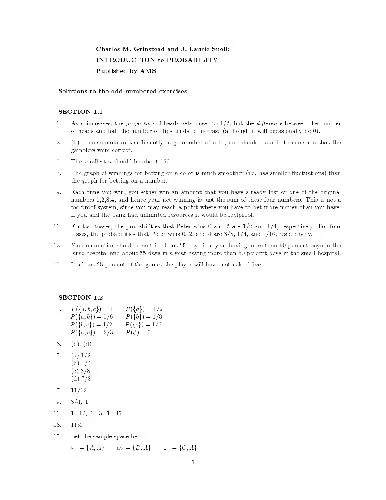
Introduction to "Introduction to Probability: Answers to Odd-Numbered Problems" The book "Introduction to Probability: Answers to Odd-Numbered Problems" is an essential companion volume to the main textbook, "Introduction to Probability". Written by J. Laurie Snell
Before you read
The book "Introduction to Probability: Answers to Odd-Numbered Problems" is an essential companion volume to the main textbook, "Introduction to Probability". Written by J. Laurie Snell and Charles M. Grinstead, this supplementary guide tackles an important aspect of learning probability: the development of problem-solving skills.
This book is designed to assist students and educators in verifying solutions, understanding key concepts in probability, and gaining confidence in solving core problems. Each answer is not merely provided but is often accompanied by clear, step-by-step explanations that reinforce the principles learned in the primary textbook. The authors aim to foster a deep understanding of probability while emphasizing practical methods of solving problems.
If you are a student delving into the fascinating world of probability or an instructor seeking materials to enhance your teaching toolkit, this book serves as a reliable resource to refine your understanding of key principles and applications of probability theory.
The book systematically addresses solutions to odd-numbered problems from the main text, "Introduction to Probability". Each chapter covers critical topics such as basic combinatorial analysis, conditional probability, random variables, distributions, and the central limit theorem. Working through these solved problems helps readers solidify their understanding by applying theoretical concepts to practical scenarios.
Key topics included in this solutions guide are:
Each solution is rendered with precision, bridging intuition with mathematical rigor. While the main focus is on providing a clear path to solving problems, this solutions manual also equips the reader with techniques and strategies applicable beyond the specific examples covered.
Working through this solutions manual offers several benefits and insights:
While this book is primarily a solutions guide, it still captures some insightful concepts about probability, as echoed by the authors’ explanations. Here are a few standout moments that highlight the beauty of probability thinking:
“The study of probability is not just about numbers; it’s about understanding uncertainty and making informed decisions in the face of randomness.”
“Solving problems in probability requires equal parts mathematical rigor and intuitive reasoning. Both are skills you can develop with practice and perseverance.”
“Every solved problem is a building block, foundational to developing mastery over complex probabilistic concepts.”
These quotes reflect the essence of the book: probability as both a science and an art that requires thoughtful study and investigation.
Probability is a cornerstone of modern mathematics, underpinning fields as diverse as data science, finance, biology, and engineering. Yet, the journey to mastering probability often begins with solving problems, and this is where "Introduction to Probability: Answers to Odd-Numbered Problems" makes its major contribution.
The book matters because it bridges the gap between theory and practice. While the main textbook builds the theoretical framework, this guide ensures the knowledge is actionable. It empowers readers to test their understanding, correct mistakes, and build confidence in their ability to tackle mathematical problems.
Furthermore, the authors’ focus on detailed explanations ensures that readers don’t merely arrive at solutions but also comprehend the thought process required. This added clarity extends the utility of the book, making it an indispensable resource for students seeking to excel in probability.
For instructors, this book offers a reliable repository of solved problems for classroom discussions or assignments. Its emphasis on clarity and accessibility ensures that it serves a wide audience, from beginners struggling with foundational concepts to advanced learners refining their skills.
In short, this solutions manual matters because it transforms the abstract intricacies of probability into digestible, practical knowledge. It’s not merely a reference but a learning tool that inspires and equips readers for success in one of the most important fields of mathematics.
Your question is answered in the context of this title and author. Each answer uses 2 points.
0 reviews, 4.0 average out of 5
Sign in to publish a review.
Ask a focused question and learn from the community.
Related references that continue this learning path.
William Feller
Michele Cini,Francesco Fucito,Mauro Sbragaglia (auth.)
Harry A. Mavromatis (auth.)