Book guide and evaluation
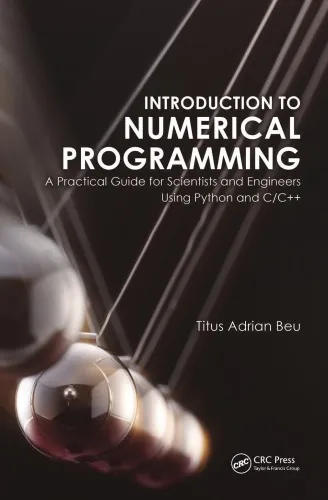
Introduction to numerical programming: a practical guide for scientists and engineers using Python and C/C++
Titus A. Beu
English
Intermediate
Engineering
4.8 / 5
0 reviews
2015
Published
663
pages
553
views
Makes Numerical Programming More Accessible to a Wider AudienceBearing in mind the evolution of modern programming, most specifically emergent programming languages that reflect modern practice, Numerical Programming: A Practical Guide for Scientists and Engineers Using Python an
Before you read
What will you get from this book?
Makes Numerical Programming More Accessible to a Wider AudienceBearing in mind the evolution of modern programming, most specifically emergent programming languages that reflect modern practice, Numerical Programming: A Practical Guide for Scientists and Engineers Using Python and C/C++ utilizes the author’s many years of practical research and teaching experience to offer a systematic approach to relevant programming concepts. Adopting a practical, broad appeal, this user-friendly book offers guidance to anyone interested in using numerical programming to solve science and engineering problems. Emphasizing methods generally used in physics and engineering?from elementary methods to complex algorithms?it gradually incorporates algorithmic elements with increasing complexity.Develop a Combination of Theoretical Knowledge, Efficient Analysis Skills, and Code Design Know-HowThe book encourages algorithmic thinking, which is essential to numerical analysis. Establishing the fundamental numerical methods, application numerical behavior and graphical output needed to foster algorithmic reasoning, coding dexterity, and a scientific programming style, it enables readers to successfully navigate relevant algorithms, understand coding design, and develop efficient programming skills. The book incorporates real code, and includes examples and problem sets to assist in hands-on learning.Begins with an overview on approximate numbers and programming in Python and C/C++, followed by discussion of basic sorting and indexing methods, as well as portable graphic functionalityContains methods for function evaluation, solving algebraic and transcendental equations, systems of linear algebraic equations, ordinary differential equations, and eigenvalue problemsAddresses approximation of tabulated functions, regression, integration of one- and multi-dimensional functions by classical and Gaussian quadratures, Monte Carlo integration techniques, generation of random variables, discretization methods for ordinary and partial differential equations, and stability analysisThis text introduces platform-independent numerical programming using Python and C/C++, and appeals to advanced undergraduate and graduate students in natural sciences and engineering, researchers involved in scientific computing, and engineers carrying out applicative calculations.
Ask this book
Your question is answered in the context of this title and author. Each answer uses 2 points.
Sign in to ask the book assistant.
Reader reviews
0 reviews, 4.8 average out of 5
No reviews yet
If you have read this book, help the next reader with your experience.
Write a review
Sign in to publish a review.
Reader questions and answers
Ask a focused question and learn from the community.
Sign in to ask or answer a question.
No questions yet
Be the first to ask a clear, useful question.
What to read next
Related references that continue this learning path.
Python Programming and Numerical Methods: A Guide for Engineers and Scientist
Qingkai Kong,Timmy Siauw,Alexandre Bayen
2020
View book