Book guide and evaluation
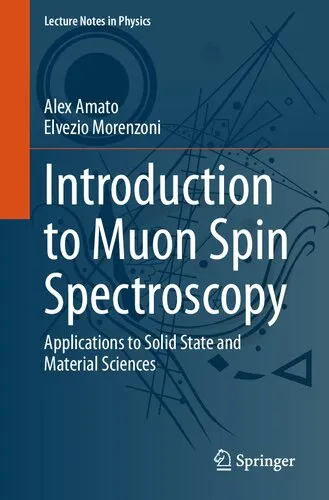
Introduction to Muon Spin Spectroscopy: Applications to Solid State and Material Sciences (Lecture Notes in Physics, 961)
Alex Amato,Elvezio Morenzoni
English
Beginner
Solid State
4.5 / 5
0 reviews
2024
Published
544
pages
573
views
Introduction to "Introduction to Muon Spin Spectroscopy" Muon Spin Spectroscopy (µSR) is a powerful technique used to investigate the structural, electronic, and magnetic properties of materials at the atomic level. This book, part of the esteemed Lecture Notes in Physic
Before you read
What will you get from this book?
Introduction to "Introduction to Muon Spin Spectroscopy"
Muon Spin Spectroscopy (µSR) is a powerful technique used to investigate the structural, electronic, and magnetic properties of materials at the atomic level. This book, part of the esteemed Lecture Notes in Physics series, serves both as an introductory text and a comprehensive reference for researchers and students in the fields of solid state and materials science.
Through the lens of muon spin spectroscopy, the book delves into the microscopic world, offering insights into how muons can be used to probe the local environments within materials. Spanning foundational theoretical concepts to practical applications, "Introduction to Muon Spin Spectroscopy: Applications to Solid State and Material Sciences" is a multidisciplinary text that connects physics, chemistry, materials science, and engineering.
Detailed Summary
This book starts by introducing the basic principles of muon spin spectroscopy and its historical development. It describes how positively charged muons, when introduced into a material, can provide information on local magnetic and electronic environments through their spin interactions. The text elaborates on the experimental setup, including muon sources, detectors, and data acquisition systems, illustrating the versatility and scope of µSR experiments.
Subsequent chapters focus on the application of µSR in studying various types of materials. The book provides detailed examples showing how muon spectroscopy has been used to investigate critical phenomena in superconductors, semiconductors, and magnetic materials. Each chapter carefully explains how µSR contributes to understanding specific characteristics of materials, such as magnetic order, electronic conductivity, and structural phase transitions.
Key Takeaways
- Makes complex concepts of muon spin spectroscopy accessible to newcomers and detailed enough for seasoned researchers.
- Offers a comprehensive overview of µSR theory, practical implementations, and varied applications.
- Features case studies and examples covering real-world material systems, showcasing µSR's investigative power.
- Demonstrates interdisciplinary connections, bridging multiple scientific fields through spectroscopy.
Famous Quotes From the Book
"Muon spin spectroscopy is not just a tool but a window into the invisible dynamics of the atomic world."
"Our understanding of complex systems is greatly enriched by the complementary perspectives provided by µSR and other spectroscopic techniques."
Why This Book Matters
In the constantly evolving world of materials science and physics, sitting at the forefront of research necessitates access to cutting-edge techniques like muon spin spectroscopy. This book provides a pivotal resource for understanding and utilizing µSR, embodying the blend of theoretical background and practical application that modern research demands.
Furthermore, as scientific inquiry becomes increasingly interdisciplinary, the ability to apply µSR across diverse fields broadens scholars' capacity to innovate. From developing new materials for technology to probing the fundamental nature of matter, the insights gained from this text allow participants in these fields to ask deeper questions and derive more comprehensive answers.
This book is not just an academic text but a valuable tool for any researcher looking to enhance their understanding of material properties on an atomic scale. Its dedication to clarity, comprehensiveness, and applicability makes it an indispensable part of a scientific library.
Ask this book
Your question is answered in the context of this title and author. Each answer uses 2 points.
Sign in to ask the book assistant.
Reader reviews
0 reviews, 4.5 average out of 5
No reviews yet
If you have read this book, help the next reader with your experience.
Write a review
Sign in to publish a review.
Reader questions and answers
Ask a focused question and learn from the community.
Sign in to ask or answer a question.
No questions yet
Be the first to ask a clear, useful question.
What to read next
Related references that continue this learning path.
Solid State Physics: Principles and Modern Applications
John J. Quinn,Kyung-Soo Yi (auth.)
2009
View book