
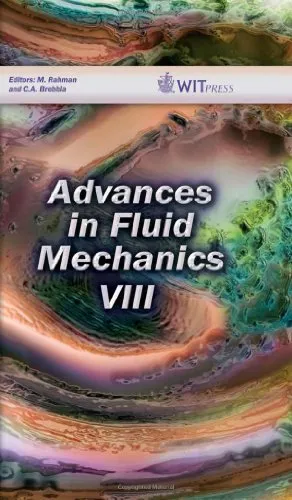
Advances in Fluid Mechanics VIII (Wit Transactions on Engineering Sciences)
M Rahman,C. A. (editors) Brebbia
2010
View book
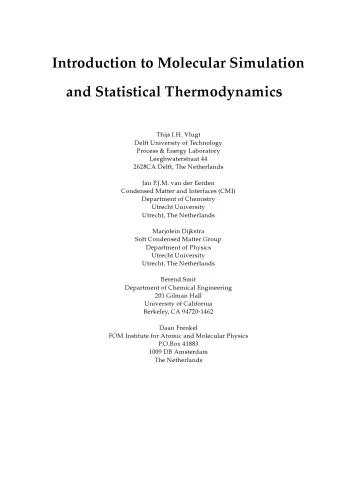
Book guide and evaluation
Thijs J.H. Vlugt et al.
0 reviews
Published
pages
views
Welcome to an exploration of the invisible world of molecules and their behaviors, as detailed in "Introduction to Molecular Simulation and Statistical Thermodynamics". This book serves as a foundational guide to understanding the principles and tools that allow us to predict
Before you read
Welcome to an exploration of the invisible world of molecules and their behaviors, as detailed in "Introduction to Molecular Simulation and Statistical Thermodynamics". This book serves as a foundational guide to understanding the principles and tools that allow us to predict and analyze the properties of molecular systems.
The book begins with an exploration into the foundational concepts of statistical thermodynamics, providing readers with a thorough understanding of how microscopic interactions lead to observable macroscopic phenomena. It emphasizes the bridge between theoretical underpinnings and practical applications, making complex ideas more accessible through clear explanations and real-world examples.
Subsequent chapters delve into the methods of molecular simulation, detailing the use of algorithms and computational techniques that model the behavior of molecules in various states and interactions. Readers gain insights into Monte Carlo and molecular dynamics simulations, learning how these tools contribute to meticulous predictions about material properties and chemical processes.
Throughout the book, a balance is struck between theory and application, with discussions on both equilibrium and non-equilibrium systems. The analytical methodologies are supplemented by a rich assortment of problems and exercises that reinforce learning and application of concepts.
"Molecular simulation allows us to conduct experiments without a laboratory, bridging gaps between theory and real-world phenomena."
"Statistical thermodynamics unveils the beautiful tapestry woven by the seemingly random motions of countless particles."
The importance of "Introduction to Molecular Simulation and Statistical Thermodynamics" is evident in its widespread influence across academic and professional spectrums. As industries increasingly rely on computational methods to design materials and understand complex chemical reactions, the knowledge contained within this book becomes invaluable.
By equipping readers with deep insights into molecular simulation, the book fosters innovation in fields such as materials science, pharmaceuticals, and chemical engineering. The ability to predict how molecules behave allows for the creation of new materials with desired properties and the improvement of existing products and processes.
Moreover, the emphasis on statistical thermodynamics enriches the reader's understanding of the fundamental laws that govern natural phenomena. This understanding is crucial not only for the advancement of scientific research but also for addressing global challenges such as energy conservation and sustainability.
In summary, this book serves as an essential resource for anyone looking to deepen their understanding of molecular simulation and statistical thermodynamics. It is crafted not only to educate but also to inspire, providing readers with the tools they need to venture into the molecular landscape and make meaningful contributions to science and technology.
Your question is answered in the context of this title and author. Each answer uses 2 points.
0 reviews, 5.0 average out of 5
Sign in to publish a review.
Ask a focused question and learn from the community.
Related references that continue this learning path.
M Rahman,C. A. (editors) Brebbia

Juan H. Vera,Grazyna Wilczek-Vera,Claudio Olivera-Fuentes,Costas Panayiotou