
Book guide and evaluation
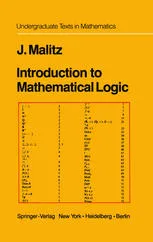
Introduction to Mathematical Logic: Set Theory Computable Functions Model Theory
Jerome Malitz (auth.)
English
Beginner
Mathematics
4.8 / 5
0 reviews
1979
Published
208
pages
458
views
Introduction to Mathematical Logic: Set Theory Computable Functions Model Theory Welcome to an exploration through the world of mathematical logic, where abstract concepts become the foundation of mathematical reasoning and application. "Introduction to Mathematical Logic" d
Before you read
What will you get from this book?
Introduction to Mathematical Logic: Set Theory Computable Functions Model Theory
Welcome to an exploration through the world of mathematical logic, where abstract concepts become the foundation of mathematical reasoning and application. "Introduction to Mathematical Logic" delves into the core areas of set theory, computable functions, and model theory, providing a gateway for students, educators, and enthusiasts alike to engage with foundational principles that drive modern logic.
Detailed Summary of the Book
In "Introduction to Mathematical Logic," Jerome Malitz offers a comprehensive examination of the fundamental topics that comprise mathematical logic. The book is structured to guide the reader through complex theories with clarity and precision, starting with the basic principles of set theory. Set theory forms the backbone of mathematics and logic, and the book covers its axioms, operations, and applications to solve logical problems.
Following set theory, the book transitions into the realm of computable functions. This section is crucial for understanding how algorithms can be constructed to solve problems, detailing concepts such as Turing machines and recursive functions. By providing a foundation in computable functions, the book lays the groundwork for further exploration into computational theory and its real-world applications.
Model theory, the third principal area covered, examines the relationships between mathematical structures and formal languages. The book articulates how models represent logical theories and how varying these models can affect the interpretations of mathematical statements. This section provokes deeper thought into how logic translates into the physical and conceptual worlds, showcasing the inherent beauty of logic.
Key Takeaways
- Foundation Building: Gain a solid understanding of the fundamental tenets of mathematical logic through set theory, computable functions, and model theory.
- Interdisciplinary Approach: Learn how mathematical logic serves as a bridge between mathematics, computer science, and philosophy.
- Critical Thinking: Develop critical thinking skills and logical reasoning abilities that are applicable across various disciplines.
Famous Quotes from the Book
"Mathematical logic is the bedrock upon which the edifice of mathematical thought stands, bridging the gap between abstract ideas and practical application."
"In understanding the computable, we unravel the threads of what can be known, solved, and decided by machines."
Why This Book Matters
This book is not only a study of mathematical logic but a resource that enhances your ability to think critically and reason logically. It condenses complex ideas into accessible formats, making it suitable for both newcomers and those with an existing background in logic. By exploring the foundations of set theory, computable functions, and model theory, readers are equipped with the tools necessary for a deeper appreciation of mathematics at both theoretical and practical levels.
Furthermore, "Introduction to Mathematical Logic" serves as a vital resource for those interested in fields beyond pure mathematics, including computer science and philosophy. Mathematical logic is a universal language that aids in solving diverse problems, making this text a crucial addition to the library of any serious student of logic.
Ask this book
Your question is answered in the context of this title and author. Each answer uses 2 points.
Sign in to ask the book assistant.
Reader reviews
0 reviews, 4.8 average out of 5
No reviews yet
If you have read this book, help the next reader with your experience.
Write a review
Sign in to publish a review.
Reader questions and answers
Ask a focused question and learn from the community.
Sign in to ask or answer a question.
No questions yet
Be the first to ask a clear, useful question.
What to read next
Related references that continue this learning path.
Combinatorial Set Theory: With a Gentle Introduction to Forcing
Lorenz J. Halbeisen (auth.)
2012
View book