

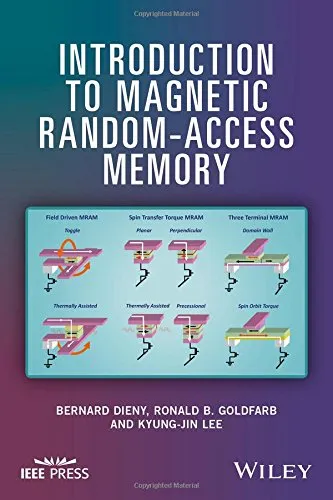
Book guide and evaluation
Introduction to magnetic random-access memory
Dieny, Bernard;Goldfarb, Ronald Barry;Lee, Kyung-Jin
English
Beginner
Engineering
4.0 / 5
0 reviews
2017
Published
255
pages
728
views
Introduction to Magnetic Random-Access Memory Welcome to an intriguing journey through the revolutionary world of Magnetic Random-Access Memory (MRAM). This book serves as a comprehensive guide to understanding the intricacies of MRAM technology and its profound impact on
Before you read
What will you get from this book?
Introduction to Magnetic Random-Access Memory
Welcome to an intriguing journey through the revolutionary world of Magnetic Random-Access Memory (MRAM). This book serves as a comprehensive guide to understanding the intricacies of MRAM technology and its profound impact on the landscape of memory storage solutions. Authored by leading experts in the field, this text provides an extensive overview designed for both academic researchers and industry professionals.
Detailed Summary of the Book
In "Introduction to Magnetic Random-Access Memory," we explore the fundamental principles that govern MRAM technology, offering insight into its evolution and future potential. The book begins with an overview of the historical context, tracing the development of memory technologies that paved the way for MRAM. It delves into topics such as the basics of magnetism and spintronics, which lay the groundwork for understanding how MRAM operates.
Readers will gain insights into the different types of MRAM, including Toggle MRAM, Spin-Transfer Torque MRAM (STT-MRAM), and the latest developments in Voltage-Controlled MRAM (VC-MRAM). Each type is meticulously analyzed, detailing their operational mechanisms, advantages, constraints, and practical applications. Additionally, the book provides a comprehensive understanding of fabrication techniques, design challenges, and integration into current technology systems.
The text also addresses the market trends and the competitive landscape of memory technologies, offering a sobering view of where MRAM stands in contrast to other paradigms. Furthermore, it speculates on emerging applications and the potential role of MRAM in future technology ecosystems such as Artificial Intelligence, Internet of Things, and Advanced Computing Systems.
Key Takeaways
- MRAM combines the speed of SRAM, the capacity of DRAM, and the non-volatility of flash memory, offering an unparalleled data retention capability with high-speed performance.
- The principles of magnetism and spintronics are central to understanding and innovating within the MRAM space.
- Designing efficient MRAM involves overcoming challenges related to scalability, power consumption, and cost-effectiveness.
- MRAM technology is poised to play a critical role in future computing paradigms, particularly tied to energy-efficient solutions and applications demanding high speed and durability.
- An understanding of MEMS and microfabrication processes is critical for advancing MRAM technology.
Famous Quotes from the Book
"The future of memory technology is not merely in increasing capacity, but in rethinking the very mechanisms of data retention." - Dieny, Bernard
"MRAM stands at the crossroads of versatility and efficiency, embodying the potential to reshape how data and technology interface." - Goldfarb, Ronald Barry
Why This Book Matters
"Introduction to Magnetic Random-Access Memory" is more than just a textbook; it is an essential resource for anyone looking to grasp the emerging field of memory technologies. As society increasingly depends on rapid, reliable data access—ranging from consumer electronics to critical applications in enterprise systems—MRAM's influence continues to grow.
By systematically unpacking the complex science underpinning MRAM, this book provides readers with the tools to appreciate and contribute to its ongoing evolution. The insights gained from this book are indispensable for professionals involved in semiconductor technologies, data storage engineering, and computing system design. Furthermore, it invites academic stakeholders to explore uncharted territories in research, prodding innovations that can redefine future memory landscapes.
Ultimately, "Introduction to Magnetic Random-Access Memory" does not merely chronicle the present; it challenges its readers to envision the future, equipping them with the knowledge and inspiration to lead in it.
Ask this book
Your question is answered in the context of this title and author. Each answer uses 2 points.
Sign in to ask the book assistant.
Reader reviews
0 reviews, 4.0 average out of 5
No reviews yet
If you have read this book, help the next reader with your experience.
Write a review
Sign in to publish a review.
Reader questions and answers
Ask a focused question and learn from the community.
Sign in to ask or answer a question.
No questions yet
Be the first to ask a clear, useful question.
What to read next
Related references that continue this learning path.
Shaping Climate Friendly Transport in Europe: Key Findings & Future Directions, REACT 2011, Proceedings
Zoran Radmilović,Dragan Čišić (eds.)
2011
View book

Advances in Non-Volatile Memory and Storage Technology
Magyari-Kope, Blanka;Nishi, Yoshio
2019
View book