Book guide and evaluation
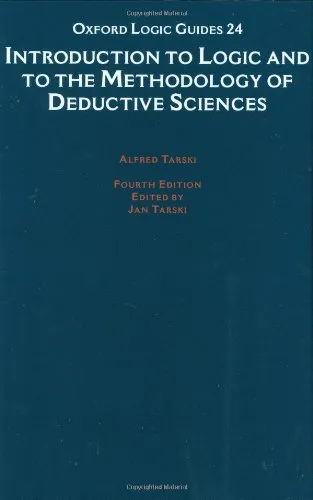
Introduction to Logic and to the Methodology of the Deductive Sciences
Alfred Tarski,Jan Tarski
English
Beginner
Mathematics
4.5 / 5
0 reviews
1994
Published
254
pages
534
views
Introduction Welcome to the detailed exploration of 'Introduction to Logic and to the Methodology of the Deductive Sciences', a seminal work by Alfred Tarski that guides readers through the foundational principles of logic and the structure of deductive reasoning.
Before you read
What will you get from this book?
Introduction
Welcome to the detailed exploration of 'Introduction to Logic and to the Methodology of the Deductive Sciences', a seminal work by Alfred Tarski that guides readers through the foundational principles of logic and the structure of deductive reasoning. This book offers an accessible approach to understanding logic's role in scientific inquiry, designed for students and scholars alike.
Detailed Summary of the Book
'Introduction to Logic and to the Methodology of the Deductive Sciences' provides an in-depth exploration of logical reasoning and its applications. The book begins with the fundamentals of classical logic, including discussions on propositions, logical connectives, and the nature of logical inference. Tarski's treatment of logic is meticulous, offering clarity on abstract principles through rigorous definitions and concise explanations.
Moving forward, the book delves into the methodology of deductive sciences, illustrating how logical principles underpin scientific theories and mathematical proofs. Tarski emphasizes the role of axioms and theorems, elucidating the process of deriving conclusions through logical argumentation. By demystifying these core aspects, the book serves as an invaluable resource for understanding the synthesis of logic and scientific methodology.
Tarski also explores the limits and limitations of formal logical systems, presenting a candid discussion on the boundaries of what can be proven within these frameworks. His insights into the incompleteness theorems and undecidability mark a profound contribution to the field, inviting readers to ponder the implications of these limitations on human knowledge and scientific discovery.
Key Takeaways
-
The foundational elements of logic, including propositions, connectives, and logical inference.
-
How axioms and theorems serve as the basis of scientific theories.
-
The methodology of constructing deductive arguments and its application in scientific contexts.
-
An understanding of the limitations of formal logical systems, including incompleteness and undecidability.
Famous Quotes from the Book
“The construction of a new system of logic consists mainly in the discovery of a simpler method of proving known theorems.”
“The logical analysis of mathematical theories usually leads to surprising results about those theories.”
Why This Book Matters
'Introduction to Logic and to the Methodology of the Deductive Sciences' is more than just a textbook; it is a crucial work that bridges the gap between logic and its application in the sciences. By presenting complex ideas with clarity and precision, Tarski empowers readers to grasp both the theoretical and practical significance of logic. This book is essential for anyone interested in the philosophical underpinnings of mathematics and the sciences, as it provides the tools necessary to critically engage with these disciplines.
Alfred Tarski's contributions to logic were revolutionary, influencing fields such as computer science, linguistics, and philosophy. This book stands as a testament to his legacy, offering insights that are still relevant in today's rapidly evolving intellectual landscape.
For students, educators, and professionals alike, understanding the principles laid out in this book is indispensable for cultivating a nuanced appreciation of logic and methodology. It not only fosters critical thinking but also inspires deeper inquiry into the nature of scientific truth and reasoning.
Ask this book
Your question is answered in the context of this title and author. Each answer uses 2 points.
Sign in to ask the book assistant.
Reader reviews
0 reviews, 4.5 average out of 5
No reviews yet
If you have read this book, help the next reader with your experience.
Write a review
Sign in to publish a review.
Reader questions and answers
Ask a focused question and learn from the community.
Sign in to ask or answer a question.
No questions yet
Be the first to ask a clear, useful question.
What to read next
Related references that continue this learning path.
First Order Categorical Logic: Model-Theoretical Methods in the Theory of Topoi and Related Categories
Michael Makkai,Gonzalo E. Reyes
1977
View book
Bridging the Gap: Philosophy, Mathematics, and Physics: Lectures on the Foundations of Science
Giovanna Corsi,Maria Luisa Dalla Chiara,Gian Carlo Ghirardi (Editors)
1993
View book