RefHub featured
Book guide and evaluation
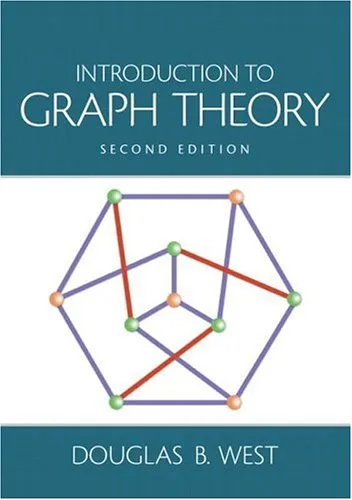
Introduction to Graph Theory
Douglas B. West
English
Beginner
Algorithms
4.5 / 5
0 reviews
2000
Published
871
pages
792
views
Introduction to Graph Theory Graph theory, a cornerstone of discrete mathematics, offers a comprehensive framework for analyzing structures through pairwise relations. "Introduction to Graph Theory" by Douglas B. West is a fundamental text in this discipline, meticulously expl
Before you read
What will you get from this book?
Introduction to Graph Theory
Graph theory, a cornerstone of discrete mathematics, offers a comprehensive framework for analyzing structures through pairwise relations. "Introduction to Graph Theory" by Douglas B. West is a fundamental text in this discipline, meticulously exploring the intricacies of graphs in both theory and application. This book serves as a bridge for students and enthusiasts, leading them from basic concepts to advanced topics with ease.
Detailed Summary of the Book
The book begins with a fundamental examination of graph concepts, starting with definitions of vertices, edges, and the various types of graphs such as directed, undirected, weighted, and unweighted graphs. The initial chapters lay a solid foundation by discussing simple graphs and their properties, followed by more complex structures like multigraphs, and hypergraphs. Emphasis is placed on understanding connectivity, paths, cycles, and trees, making these concepts accessible through illustrative examples and exercises.
Advanced topics are introduced with a careful progression, covering subjects such as Eulerian paths, Hamiltonian cycles, graph coloring, and matchings. The book also delves into planar graphs and their significance, providing insight into the realms of topology. These discussions are enriched by historical context and practical applications, exemplifying the relevance of graph theory in areas like computer science, biology, and social network analysis.
Notably, the text concludes with modern developments and open problems in graph theory, encouraging readers to engage with ongoing research. The book's structure is deliberately designed to foster a deep understanding, blending theoretical underpinnings with practical problem-solving skills.
Key Takeaways
- Comprehensive coverage of fundamental graph concepts including trees, circuits, and connectivity.
- Thorough exploration of advanced topics like network flows, algorithmic graph theory, and spectral graph theory.
- Emphasis on problem-solving abilities with numerous examples and exercises.
- A historical perspective that underscores the evolution and application of graph theory in various fields.
- Introduction to contemporary problems and open questions in the field, encouraging further exploration and research.
Famous Quotes from the Book
"Graphs are not just abstract mathematical entities; they are tools that allow us to model and solve real-world problems."
"The beauty of graph theory lies in its simplicity and universality, wherein complex problems can often be distilled into basic graph terms."
Why This Book Matters
Douglas B. West's "Introduction to Graph Theory" is more than just a textbook; it is a vital resource in academia and beyond. Its structured approach makes graph theory accessible to a wide audience, from undergraduates to advanced researchers. The book plays a crucial role in the curriculum of discrete mathematics, providing the groundwork for computer science, operations research, combinatorics, and network analysis. Its impact extends internationally, influencing how graph theory is taught and understood across disciplines.
Moreover, as our world becomes increasingly interconnected, the importance of understanding complex networks grows. Graph theory is at the heart of these analyses, and this book equips readers with the tools needed to navigate these challenges, offering insights that are directly applicable to modern technological and scientific problems.
In essence, "Introduction to Graph Theory" stands as a testament to the elegance and utility of mathematics in understanding the intricacies of the world around us.
Ask this book
Your question is answered in the context of this title and author. Each answer uses 2 points.
Sign in to ask the book assistant.
Reader reviews
0 reviews, 4.5 average out of 5
No reviews yet
If you have read this book, help the next reader with your experience.
Write a review
Sign in to publish a review.
Reader questions and answers
Ask a focused question and learn from the community.
Sign in to ask or answer a question.
No questions yet
Be the first to ask a clear, useful question.
What to read next
Related references that continue this learning path.