
Book guide and evaluation
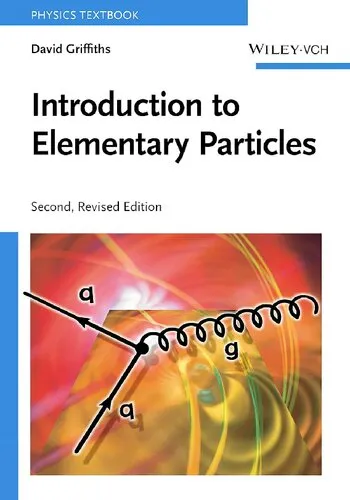
Introduction to Elementary Particles, 2nd revised edition
David J. Griffiths
English
Beginner
Physics
4.7 / 5
0 reviews
2008
Published
473
pages
740
views
Introduction to the Book "Introduction to Elementary Particles, 2nd Revised Edition" is a comprehensive guide to the fundamental building blocks of matter and their interactions. Written by David J. Griffiths, this book bridges the gap between theoretical understanding and
Before you read
What will you get from this book?
Introduction to the Book
"Introduction to Elementary Particles, 2nd Revised Edition" is a comprehensive guide to the fundamental building blocks of matter and their interactions. Written by David J. Griffiths, this book bridges the gap between theoretical understanding and practical knowledge, offering readers a lucid and in-depth exploration of the fascinating world of particle physics. Ideal for undergraduate students with a background in quantum mechanics, the text combines mathematical rigor with clear and engaging explanations, making it an indispensable resource for anyone interested in the nature of the universe at its smallest scale.
Summary of the Book
The second revised edition of "Introduction to Elementary Particles" builds on the legacy of the first edition by updating the content to reflect new discoveries and advancements in the field of particle physics. This book covers the essentials of particle physics, starting with the historical development of the subject and proceeding to the modern Standard Model of quarks, leptons, and gauge bosons. Each chapter systematically deals with a specific aspect of elementary particles, from symmetries and conserved quantities to quantum electrodynamics (QED) and chromodynamics (QCD).
Griffiths uses an intuitive narrative to explain experimental techniques, the classification of particles, and the interplay of forces at subatomic scales. The book delves into the mathematics of group theory and Feynman diagrams to elucidate complex interactions. It also examines cutting-edge topics, such as neutrino mixing, the Higgs mechanism, and CP violation. By integrating theoretical tools and experimental data, this book provides a balanced approach to understanding the principles underlying particle physics.
Numerous exercises, examples, and thought-provoking questions are provided throughout, making it a perfect resource for students seeking a deeper appreciation of the subject. The second edition also includes additional topics and up-to-date experimental results, aligning the content with modern developments in high-energy physics.
Key Takeaways
- A thorough introduction to the Standard Model and its components, including quarks, leptons, and bosons.
- A detailed discussion of gauge theories, quantum chromodynamics, and electroweak unification.
- Explanation of particle decays, scattering processes, and Feynman diagrams with clear examples.
- Insight into experimental findings, such as neutrino oscillations and the Higgs boson discovery.
- Tools and techniques for problem-solving in modern particle physics, reinforced by exercises and worked examples.
Famous Quotes from the Book
"Symmetry provides the foundation for our understanding of the physical world, dictating the laws that govern the behavior of particles at the most fundamental level."
"The Standard Model is one of the crowning achievements of modern science, offering both elegance and predictive power in its description of the universe."
Why This Book Matters
"Introduction to Elementary Particles, 2nd Revised Edition" is a cornerstone text in the field of particle physics education. What sets this book apart is its ability to merge clarity with precision, offering readers a deep yet accessible insight into a highly technical subject. By building from fundamental principles and gradually introducing more advanced topics, it equips learners with both the theoretical and practical tools needed to engage with high-energy physics.
The importance of this book lies in its pedagogical strengths. Griffiths employs intuitive explanations, illustrative examples, and a conversational tone, making complex ideas more approachable. Furthermore, the book emphasizes the connection between theory and experiment, stressing how the mathematical framework corresponds to observable phenomena.
This book is essential not just for students of physics but also for anyone curious about the underlying structure of the universe. By demystifying the intricate dance of particles and forces, it paves the way for future advancements in theoretical and experimental physics. Whether you are preparing for advanced research or simply expanding your knowledge, "Introduction to Elementary Particles" is a timeless masterpiece that will deepen your understanding of the cosmos.
Ask this book
Your question is answered in the context of this title and author. Each answer uses 2 points.
Sign in to ask the book assistant.
Reader reviews
0 reviews, 4.7 average out of 5
No reviews yet
If you have read this book, help the next reader with your experience.
Write a review
Sign in to publish a review.
Reader questions and answers
Ask a focused question and learn from the community.
Sign in to ask or answer a question.
No questions yet
Be the first to ask a clear, useful question.
What to read next
Related references that continue this learning path.
Modern Theories of Many-Particle Systems in Condensed Matter Physics
Subir Sachdev (auth.),Daniel C. Cabra,Andreas Honecker,Pierre Pujol (eds.)
2012
View book
The Feynman Lectures on Physics, Vol. III: The New Millennium Edition: Quantum Mechanics
Richard P. Feynman,Robert B. Leighton,Matthew Sands
2011
View book