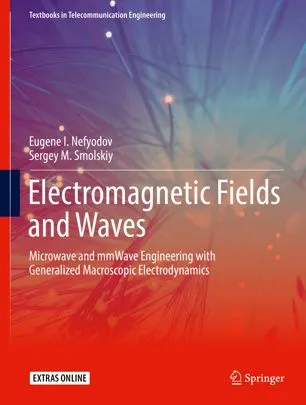
Electromagnetic Fields and Waves: Microwave and mmWave Engineering with Generalized Macroscopic Electrodynamics
Eugene I. Nefyodov,Sergey M. Smolskiy
2019
View book
Book guide and evaluation
WALTER T. GRANDY (Eds.)
0 reviews
Published
pages
views
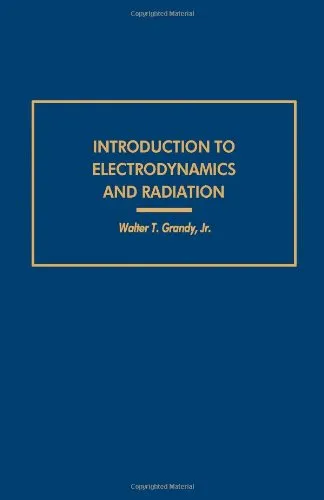
Introduction to 'Introduction to Electrodynamics and Radiation' Welcome to an engaging exploration of electrodynamics and the intricate world of radiation. 'Introduction to Electrodynamics and Radiation' aims to create a thorough understanding of fundamental concepts and
Before you read
Welcome to an engaging exploration of electrodynamics and the intricate world of radiation. 'Introduction to Electrodynamics and Radiation' aims to create a thorough understanding of fundamental concepts and foster a deep appreciation for the principles that govern electromagnetic theory and its application.
The book delves into the essentials of electrodynamics, bridging classical concepts with modern scientific advancements. It starts by laying a solid foundation in mathematical principles crucial for understanding electromagnetic phenomena, including vector calculus and complex numbers. As you progress, you'll encounter a systematic presentation of Maxwell's equations, elaborating on the elegance and power these equations encapsulate in describing electric and magnetic fields.
The narrative comfortably transitions into analyzing electromagnetic waves, offering insights into their propagation in different media and their interaction with matter. As radiation becomes a focal point, the text examines the various types of electromagnetic radiation, emphasizing the critical role played by light, its dual nature, and practical applications such as optics and telecommunications.
Perhaps one of the most intriguing aspects of the book is its treatment of the principles of radiating systems. The discussion stretches from simple antennas to complex radiation patterns, shedding light on how technological systems harness the power of radiation for functionality ranging from broadcasting to navigation. Each chapter is interwoven with problem-solving sets that challenge your understanding and solidify the integration of theory with practical scenarios.
"Electrodynamics weaves the fabric of the universe, making visible the unseen beauty of nature's forces."
"In the dance of particles and waves, we find the rhythm of light and the harmony within chaos."
'Introduction to Electrodynamics and Radiation' holds significance not just as a textbook for students but as a gateway to understanding the critical forces that shape our technological society. It bridges the gap between academic theory and practical application, serving as a valuable resource for students, educators, and professionals alike. Electrodynamics forms the backbone of advancements in numerous fields, including physics, engineering, and telecommunications.
The book's structured approach ensures that readers, whether novices or seasoned professionals, can navigate complex topics with clarity and confidence. By synthesizing classical theory with modern insights, it encourages a comprehensive learning experience. With an emphasis on problem-solving and real-world application, this book not only informs but inspires, making it an indispensable addition to the library of those passionate about the wonders of electromagnetic theory and its role in our everyday lives.
Your question is answered in the context of this title and author. Each answer uses 2 points.
0 reviews, 4.9 average out of 5
Sign in to publish a review.
Ask a focused question and learn from the community.
Related references that continue this learning path.
Eugene I. Nefyodov,Sergey M. Smolskiy

Andrej F. Alexandrov,L. S. Bogdankevich,A. A. Rukhadze