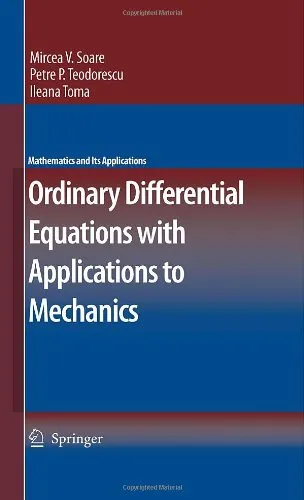
Ordinary Differential Equations with Applications to Mechanics
Mircea V. Soare,Petre P. Teodorescu,Ileana Toma (auth.)
2007
View book
Book guide and evaluation
Srinvasan
0 reviews
Published
pages
views
Introduction to "Introduction to Differential Equations and Their Applications" "Introduction to Differential Equations and Their Applications" is a meticulously crafted book designed to bridge the gap between pure mathematical theory and practical applications. Targeted a
Before you read
"Introduction to Differential Equations and Their Applications" is a meticulously crafted book designed to bridge the gap between pure mathematical theory and practical applications. Targeted at students, educators, and professionals, this book not only serves as an insightful introduction to differential equations but also equips readers with the necessary tools to apply these mathematical concepts in real-world scenarios. From modeling natural phenomena to solving engineering challenges, differential equations are the cornerstone of many scientific disciplines. This book ensures a balanced approach by blending clarity in theoretical concepts with practical relevance for a variety of fields.
The book systematically introduces differential equations, starting from the basics and gradually exploring more complex and sophisticated topics. Beginning with first-order differential equations, the text lays a strong foundation with an extensive discussion on their solution techniques, real-life applications, and graphical interpretations. Moving ahead, the book delves into higher-order differential equations, exploring linear and non-linear systems with practical examples wherever relevant.
One of the book's distinguishing features is its focus on applied mathematics. Be it population dynamics, electrical circuits, fluid mechanics, or chemical reactions, the book offers a myriad of examples where differential equations play a pivotal role. Specific chapters are dedicated to techniques like Laplace transforms, Fourier series, and numerical methods, which are indispensable tools for solving differential equations in applied settings. The inclusion of breakthrough advances in software-driven approaches offers a glimpse into modern-day problem-solving methods.
Written with a clear and accessible style, this book caters to both beginners seeking an introduction and advanced learners desiring deeper insight. Each chapter concludes with an extensive problem set, encouraging hands-on learning and mastery of the topic.
"Differential equations are not just mathematical tools; they are the language in which nature speaks to us."
"A problem well-posed is a problem half-solved. Formulating a real-world problem into a differential equation is as critical as solving it."
"Behind every breakthrough in engineering or science, you'll often find a differential equation at its heart."
The importance of understanding differential equations cannot be overstated. These mathematical formulations are central to describing dynamic systems in physics, chemistry, biology, economics, and engineering. However, many students struggle to connect the theoretical nuances of differential equations with their practical implications. This is where "Introduction to Differential Equations and Their Applications" shines.
By providing a coherent and well-structured narrative, the book demystifies the subject and empowers readers with the confidence to tackle both academic challenges and real-world problems. Its inclusion of historical context, modern techniques, and computational tools makes it invaluable not only to students but also to educators designing curricula and professionals solving complex systems.
The book also aims to fuel deeper exploration in applied mathematics, inspiring researchers to think creatively and approach challenges with an analytical mindset. From fostering problem-solving skills to bridging the gap between theory and application, this book is an essential resource for anyone eager to understand the power and beauty of differential equations.
Your question is answered in the context of this title and author. Each answer uses 2 points.
0 reviews, 4.5 average out of 5
Sign in to publish a review.
Ask a focused question and learn from the community.
Related references that continue this learning path.
Mircea V. Soare,Petre P. Teodorescu,Ileana Toma (auth.)
Palaniappan Kannappan (auth.)
Jae-Hyeong Bae,Won-Gil Park (auth.),Themistocles M. Rassias (eds.)