

Book guide and evaluation
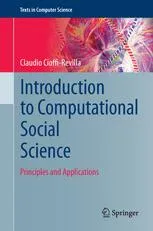
Introduction to Computational Social Science: Principles and Applications
Claudio Cioffi-Revilla
English
Beginner
Software Engineering
4.4 / 5
0 reviews
2014
Published
342
pages
193
views
Introduction to Computational Social Science: Principles and Applications Welcome to the interdisciplinary and exciting world of computational social science! My book, “Introduction to Computational Social Science: Principles and Applications”, serves as a gateway for
Before you read
What will you get from this book?
Introduction to Computational Social Science: Principles and Applications
Welcome to the interdisciplinary and exciting world of computational social science! My book, “Introduction to Computational Social Science: Principles and Applications”, serves as a gateway for readers to explore this burgeoning field that merges computer science with social sciences. By combining scientific principles, mathematical modeling, algorithmic thinking, and real-world applications, this book equips readers with a solid foundation in understanding how computational techniques can be applied to study complex social phenomena.
Detailed Summary of the Book
In the book, I have aimed to balance theory, methodology, and practical application, making it suitable for both beginners and experienced researchers in the field. Computational social science (CSS) is the study of social systems and human behavior using computational tools and methods. This book introduces the principles of CSS while addressing its practical aspects through clear examples, algorithms, and exercises.
The text begins by defining computational social science and discussing its origin and growth. It emphasizes the importance of an interdisciplinary approach that draws from areas such as sociology, political science, economics, and anthropology, as well as computer science, mathematics, and complexity science. Throughout its pages, readers will find a detailed exploration of key topics such as agent-based modeling, social network analysis, evolutionary modeling, and big data analytics in social contexts.
The book is also practical in its focus. Core computational tools and platforms – such as NetLogo and R, which are indispensable in this field – are introduced and applied to real-world examples. The exercises at the end of each chapter are designed not only to solidify learning but also to inspire critical thinking and creativity when addressing social science questions computationally.
Key Takeaways
- An understanding of the foundational principles of computational social science (CSS).
- The ability to apply key computational tools and simulation techniques, including agent-based modeling and social network analysis.
- Practical programming skills for conducting CSS research, with examples in environments like NetLogo and R.
- Insights into modeling dynamic social systems and analyzing emergent phenomena in human societies.
- An appreciation for interdisciplinary approaches that combine social theory with computational rigor.
Famous Quotes from the Book
Throughout the book, I have captured the essence of CSS with insights that aim to resonate with readers and spark their enthusiasm for the field. Here are a few memorable quotes:
"In an increasingly interconnected world, computational social science is not just a method for understanding societies – it is a necessity."
"The power of modeling lies in its ability to simplify complexity, guiding us to uncover deeper truths about human behavior and social systems."
"No single discipline holds the key to solving the most pressing societal challenges. Computational social science thrives precisely because it is a bridge between worlds."
Why This Book Matters
The study of social behavior has never been more important than in today’s rapidly changing world. From addressing global challenges like climate change and pandemics to understanding emerging phenomena like social media dynamics and political polarization, CSS offers the tools to analyze and solve complex social problems scientifically.
This book strives to be both comprehensive and accessible. Whether you are a student new to the field or a professional seeking to expand your skill set, it is designed to teach not only the theories and methodologies but also inspire innovative thinking in solving real-world problems. CSS is at the forefront of 21st-century science, and by engaging with this book, readers equip themselves to leverage computation in addressing the deepest complexities of human societies.
Moreover, this text represents a broader call to action for researchers and scholars – a call to embrace computational tools and methods to complement traditional theories and qualitative techniques. In doing so, we push the boundaries of knowledge and create the potential for impactful insights that can lead to meaningful societal change.
Embark on this journey into computational social science. Together, let us unravel and model the complexities of human societies, one discovery at a time.
Ask this book
Your question is answered in the context of this title and author. Each answer uses 2 points.
Sign in to ask the book assistant.
Reader reviews
0 reviews, 4.4 average out of 5
No reviews yet
If you have read this book, help the next reader with your experience.
Write a review
Sign in to publish a review.
Reader questions and answers
Ask a focused question and learn from the community.
Sign in to ask or answer a question.
No questions yet
Be the first to ask a clear, useful question.
What to read next
Related references that continue this learning path.


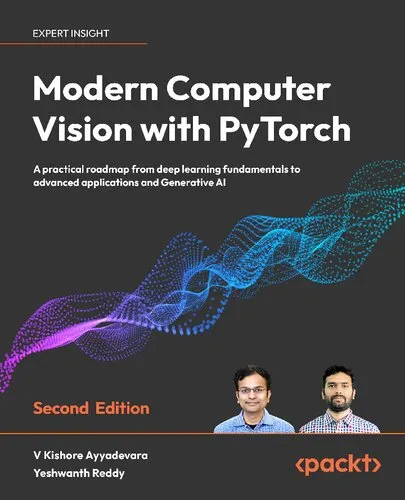
Modern Computer Vision with PyTorch: A Practical Roadmap From Deep Learning Fundamentals to Advanced Applications and Generative AI, 2nd Edition
V Kishore Ayyadevara,Yeshwanth Reddy
2023
View book