
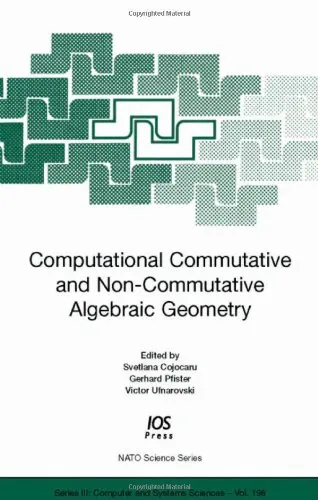
Computational commutative and non-commutative algebraic geometry
Svetlana Cojocaru,Svetlana Cojocaru,Gerhard Pfister,Victor Ufnarovski
2005
View book
Book guide and evaluation
Ernst Kunz
0 reviews
Published
pages
views
Introduction to Commutative Algebra and Algebraic Geometry Welcome to the world of commutative algebra and algebraic geometry, where abstract algebraic concepts meet geometric interpretations. "Introduction to Commutative Algebra and Algebraic Geometry" by Ernst Kunz serve
Before you read
Welcome to the world of commutative algebra and algebraic geometry, where abstract algebraic concepts meet geometric interpretations. "Introduction to Commutative Algebra and Algebraic Geometry" by Ernst Kunz serves as a comprehensive guide for aspiring mathematicians and experienced researchers alike, exploring the deep connections between these two fascinating fields.
The book primarily focuses on bridging the gap between commutative algebra and algebraic geometry, providing readers with a solid foundation in both subjects. It starts with basic concepts of commutative algebra, including rings and modules, ideals, and ring homomorphisms. As the chapters progress, the book delves deeper into more complex topics like Noetherian rings, integral dependence, and dimension theory.
Ernst Kunz elegantly transitions from commutative algebra to algebraic geometry, illustrating how algebraic structures offer valuable insights into geometric problems. The latter sections of the book highlight prominent theorems and concepts such as Hilbert's Nullstellensatz, sheaf theory, and the local-global principles that govern algebraic varieties. The text excels at making intricate concepts approachable by employing numerous examples and exercises designed to deepen understanding and enhance practical skills.
“In mathematics, the art of proposing a question must be held of higher value than solving it.”
“The journey from algebra to geometry is paved with insights that reshape our understanding of both, where each theorem tells a story of infinite complexity.”
This book is significant for several reasons. First, it successfully unites two essential areas of modern mathematics, revealing the symphonic relationship between algebra and geometry. The careful presentation by Ernst Kunz allows for an intricate look into how algebraic systems model geometric phenomena, equipping readers with a versatile toolset for tackling persistent mathematical challenges.
Moreover, this book provides an indispensable resource for students and researchers wanting a deep dive into algebraic techniques that serve as the backbone for advanced studies in areas such as coding theory, cryptography, and complex manifolds. Kunz's book is notable not just for its academic rigor but for its ability to inspire awe in the harmonies found in mathematical ideas.
Your question is answered in the context of this title and author. Each answer uses 2 points.
0 reviews, 4.5 average out of 5
Sign in to publish a review.
Ask a focused question and learn from the community.
Related references that continue this learning path.
Svetlana Cojocaru,Svetlana Cojocaru,Gerhard Pfister,Victor Ufnarovski
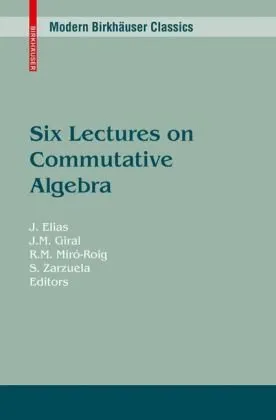
J. Elias,J. M. Giral,Rosa M. Miró-Roig,Santiago Zarzuela
Igor R. Shafarevich (auth.)