Loading
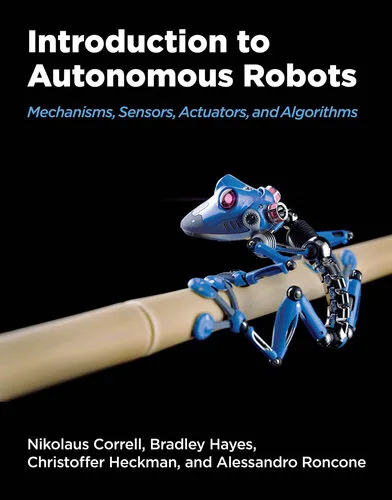
Cover of Introduction to Autonomous Robots: Mechanisms, Sensors, Actuators, and Algorithms

Book guide and evaluation

Introduction to Autonomous Robots: Mechanisms, Sensors, Actuators, and Algorithms

Nikolaus Correll,Bradley Hayes,Christoffer Heckman,Alessandro Roncone

English Intermediate Artificial Intelligence (AI)
4.5 / 5

0 reviews

2022

Published

288

pages

432

views

A comprehensive introduction to the field of autonomous robotics aimed at upper-level undergraduates and offering additional online resources.Textbooks that provide a broad algorithmic perspective on the mechanics and dynamics of robots almost unfailingly serve students at the gr

Before you read

What will you get from this book?

A comprehensive introduction to the field of autonomous robotics aimed at upper-level undergraduates and offering additional online resources.Textbooks that provide a broad algorithmic perspective on the mechanics and dynamics of robots almost unfailingly serve students at the graduate level. Introduction to Autonomous Robots offers a much-needed resource for teaching third- and fourth-year undergraduates the computational fundamentals behind the design and control of autonomous robots. The authors use a class-tested and accessible approach to present progressive, step-by-step development concepts, alongside a wide range of real-world examples and fundamental concepts in mechanisms, sensing and actuation, computation, and uncertainty. Throughout, the authors balance the impact of hardware (mechanism, sensor, actuator) and software (algorithms) in teaching robot autonomy. Features:Rigorous and tested in the classroomWritten for engineering and computer science undergraduates with a sophomore-level understanding of linear algebra, probability theory, trigonometry, and statisticsQR codes in the text guide readers to online lecture videos and animationsTopics include: basic concepts in robotic mechanisms like locomotion and grasping, plus the resulting forces; operation principles of sensors and actuators; basic algorithms for vision and feature detection; an introduction to artificial neural networks, including convolutional and recurrent variantsExtensive appendices focus on project-based curricula, pertinent areas of mathematics, backpropagation, writing a research paper, and other topicsA growing library of exercises in an open-source, platform-independent simulation (Webots)

Ask this book

Your question is answered in the context of this title and author. Each answer uses 2 points.

Sign in to ask the book assistant.

Reader reviews

0 reviews, 4.5 average out of 5

No reviews yet

If you have read this book, help the next reader with your experience.

Write a review

Sign in to publish a review.

Reader questions and answers

Ask a focused question and learn from the community.

Sign in to ask or answer a question.

No questions yet

Be the first to ask a clear, useful question.