
Book guide and evaluation
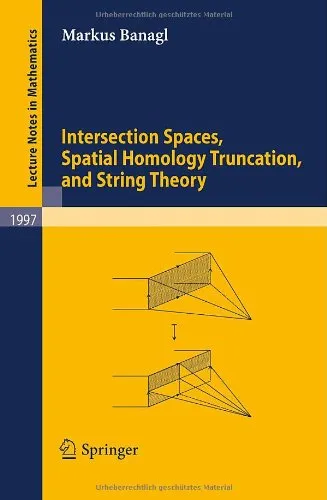
Intersection Spaces, Spatial Homology Truncation, and String Theory
Markus Banagl (auth.)
English
Beginner
Algebra
4.0 / 5
0 reviews
2010
Published
240
pages
636
views
Introduction Welcome to "Intersection Spaces, Spatial Homology Truncation, and String Theory," a groundbreaking exploration into the geometrical and topological aspects of string theory. This book serves as a comprehensive guide for both seasoned researchers and those ne
Before you read
What will you get from this book?
Introduction
Welcome to "Intersection Spaces, Spatial Homology Truncation, and String Theory," a groundbreaking exploration into the geometrical and topological aspects of string theory. This book serves as a comprehensive guide for both seasoned researchers and those new to the field, delving into the mathematical intricacies that underpin this fascinating area of theoretical physics. Written by Markus Banagl, a leading figure in the field, this work aims to bridge the gap between pure mathematics and the applied sciences particularly related to string theory.
Detailed Summary of the Book
"Intersection Spaces, Spatial Homology Truncation, and String Theory" offers an in-depth analysis of the mathematical structures that arise in string theory, particularly focusing on intersection spaces and spatial homology truncation. These concepts are pivotal in understanding the anomalies and intricacies involved in high-dimensional spaces often encountered in string theoretical models. The book systematically unfolds the underlying geometry and topology, introducing intersection space theory as a tool to study singularities commonly present in the physical spacetime fabric posited by string theory.
Banagl provides readers with rigorous proofs, theorem formulations, and detailed examples to illustrate the practical applications of these mathematical concepts. The text covers the core principles of spatial homology truncation and extends the discussion to include advanced topics such as virtual spaces, duality, and their implications in physical theories. By integrating complex mathematical ideas with string theoretical contexts, this book stands as a valuable asset for expanding the horizons of both mathematicians and theoretical physicists.
Key Takeaways
- Comprehensive introduction to intersection spaces and their role in string theory.
- Detailed exploration of spatial homology truncation and its mathematical foundations.
- Insights into the application of topology and geometry in addressing challenges within string theory.
- Enhanced understanding of singularities in high-dimensional models and potential resolutions.
Famous Quotes from the Book
"Mathematics is the language with which string theory speaks, and intersection spaces are its dialect, rich and varied to unfold the universe's most profound secrets."
"In the realm of high-energy physics, where the spirit of exploration meets the rigors of mathematics, spatial homology truncation offers a map through the abstract territory of singularities."
Why This Book Matters
This book holds significant importance due to its innovative approach to bridging mathematics and physics, particularly in the context of string theory. As modern physics continues to probe deeper into the fundamentals of reality, understanding the mathematical structures that describe high-dimensional phenomena becomes increasingly crucial. Markus Banagl's work offers invaluable insights and methodologies that can shape the future of research in string theory and beyond. Readers will not only gain a deeper appreciation of the interconnectedness of mathematics and physics but also be equipped with the tools needed to tackle complex problems in their field.
Additionally, the book addresses gaps that often exist between theoretical and applied sciences, making it a crucial resource for anyone looking to make strides in theoretical physics or advanced mathematical research. Through this synergy, new discoveries may eventually influence technologies and principles that guide us toward a more comprehensive understanding of the universe.
Ask this book
Your question is answered in the context of this title and author. Each answer uses 2 points.
Sign in to ask the book assistant.
Reader reviews
0 reviews, 4.0 average out of 5
No reviews yet
If you have read this book, help the next reader with your experience.
Write a review
Sign in to publish a review.
Reader questions and answers
Ask a focused question and learn from the community.
Sign in to ask or answer a question.
No questions yet
Be the first to ask a clear, useful question.
What to read next
Related references that continue this learning path.
Geometric group theory. Geneva and Barcelona conferences
Goulnara N. Arzhantseva,Goulnara N. Arzhantseva,Laurent Bartholdi,José Burillo,Enric Ventura
2007
View book
Geometry, Algebra and Applications: From Mechanics to Cryptography
Marco Castrillón López,Luis Hernández Encinas,Pedro Martínez Gadea,Mª Eugenia Rosado María (eds.)
2016
View book
Combinatorial Aspects of Commutative Algebra and Algebraic Geometry: The Abel Symposium 2009 (Abel Symposia, 6)
Gunnar Fløystad (editor),Trygve Johnsen (editor),Andreas Leopold Knutsen (editor)
2011
View book