
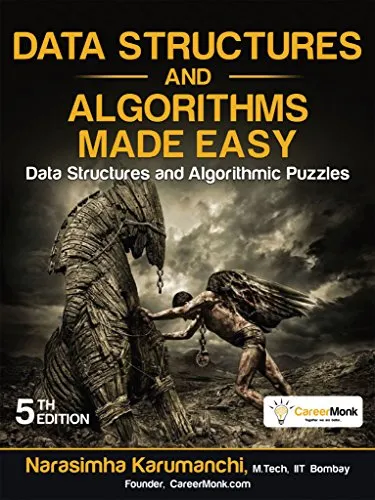
Data Structures and Algorithms Made Easy: Data Structures and Algorithmic Puzzles
Narasimha Karumanchi
2017
View book
![Cover of Interpretable Machine Learning 2ed(2022) [Molnar] [9798411463330]](https://s3.refhub.ir/images/thumb/Interpretable_Machine_Learning_2ed_2022___Mol_31481.webp)
Book guide and evaluation
Molnar
0 reviews
Published
pages
views
Introduction to "Interpretable Machine Learning - 2nd Edition" Machine learning has revolutionized industries, driving breakthroughs in healthcare, finance, and technology. Yet, with its rise comes an equally important challenge: interpretability. As algorithms g
Before you read
Machine learning has revolutionized industries, driving breakthroughs in healthcare, finance, and technology. Yet, with its rise comes an equally important challenge: interpretability. As algorithms grow in complexity, understanding how and why these systems make decisions is critical—not only for debugging and improving performance but also for ensuring fairness, accountability, and trust. "Interpretable Machine Learning - 2nd Edition" addresses this very issue, providing a comprehensive guide to demystifying machine learning models while maintaining rigor and practicality.
Authored by Christoph Molnar, this updated and extended edition is an essential resource for data scientists, researchers, engineers, and policymakers working in applied AI. Written with a blend of clarity and technical depth, the book covers methodologies, frameworks, and tools for creating explainable machine learning models. Whether you're an experienced practitioner or a newcomer seeking to bridge the gap between accuracy and interpretability, this book is your guide. It combines theoretical foundations with practical examples, making it accessible and actionable.
The journey through "Interpretable Machine Learning" begins with defining what interpretability means and why it is critical. The author emphasizes that interpretability is not just a feature; it is a necessity in real-world machine learning applications. The book introduces key concepts of interpretable models, like linear regression and decision trees, before delving into more complex solutions for opaque models, such as feature attribution and post-hoc explanation methods.
Chapters explore practical tools like SHAP (Shapley Additive Explanation), LIME (Local Interpretable Model-agnostic Explanations), and counterfactual explanations. The text also investigates trade-offs between model interpretability and predictive accuracy and discusses when practitioners should favor one over the other. Ethical concerns, biases in AI, and applications in sensitive domains further reinforce the importance of interpretable models. With hands-on Python code examples, Molnar ensures that readers can easily translate theoretical insights into their day-to-day workflows.
Finally, Molnar concludes by reflecting on the future of interpretable machine learning, exploring how research and technology might evolve to meet growing demands for transparency and accountability in AI systems.
"As machine learning becomes ubiquitous, the trust we place in algorithms hinges on how well we understand them."
"Interpretable models should not only explain predictions but also reveal the limitations and biases of the data."
"An interpretable model is not always a simpler model—it is one that offers insights relevant to the context."
"Interpretable Machine Learning - 2nd Edition" is more than a technical manual. It addresses pressing issues at the heart of AI adoption in the modern world, such as fairness, accountability, and the need for trustable decision-making systems. The book equips readers to tackle challenges in domains like healthcare, criminal justice, and finance, where understanding the decisions of machine learning models is critical for both ethical and practical reasons.
By emphasizing both intrinsic interpretability and post-hoc explanations, the book fosters a holistic understanding of how to make machine learning systems more transparent. The inclusion of Python code examples makes it a pragmatic resource for professionals looking to implement these methods in real-world projects. Furthermore, by addressing ethical implications and common pitfalls, Molnar ensures that readers not only build interpretable systems but also deploy them responsibly.
Your question is answered in the context of this title and author. Each answer uses 2 points.
0 reviews, 4.6 average out of 5
Sign in to publish a review.
Ask a focused question and learn from the community.
Related references that continue this learning path.
Narasimha Karumanchi

Hugo Jair Escalante,Sergio Escalera,Isabelle Guyon,Xavier Baró,Yağmur Güçlütürk,Umut Güçlü,Marcel van Gerven