
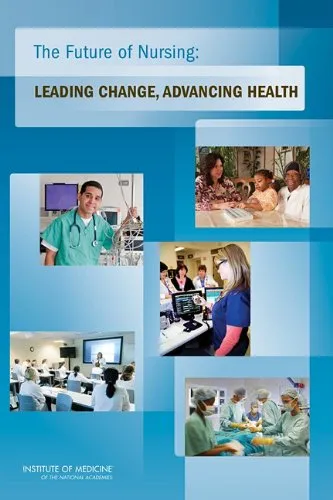
The Future of Nursing: Leading Change, Advancing Health
at the Institute of Medicine Committee on the Robert Wood Johnson Foundation Initiative on the Future of Nursing,Institute of Medicine
2010
View book

Book guide and evaluation
Tim Morse
0 reviews
Published
pages
views
International Emergency Nursingpp.63 Global emergency care practices, cross-cultural nursing approaches International Emergency Nursingpp.63 explores critical global emergency care insights for professionals and academics worldwide. Analytical Summary The book Int
Before you read
The book International Emergency Nursingpp.63 offers a focused examination of emergency nursing across diverse international contexts, bringing to light the shared challenges and distinct solutions found in global healthcare systems. Written with precision and academic rigor, the volume delves into clinical case studies, structural comparisons of emergency services, and the human dimensions of nursing in crisis settings.
Rather than confining itself to a single country’s perspective, this work builds bridges between various health systems, illuminating how different cultures approach emergency care education, on-the-ground triage, and patient communication under pressure. It incorporates evidence-based practices and critical reflections, ensuring that readers—whether practitioners, policymakers, or scholars—can glean applicable lessons.
Information such as the exact publication year and any literary awards is unavailable due to no reliable public source confirming these details. Nonetheless, the content’s relevance is evident through its sustained applicability in the evolving domain of emergency nursing on a global scale.
By distilling each major insight, International Emergency Nursingpp.63 equips readers with an understanding that transcends borders, offering frameworks and methods adaptable to almost any emergency care environment.
Firstly, the text underscores the importance of cultural competence in emergency nursing—how sensitivity to patients’ cultural backgrounds affects trust, compliance, and outcomes during critical situations.
Secondly, it highlights resource prioritization, teaching professionals how to efficiently allocate scarce medical supplies while maintaining patient safety. Such strategies are informed by both international case studies and practical wisdom.
Thirdly, the work emphasizes interprofessional collaboration, reinforcing that successful emergency care depends on seamless communication between nurses, physicians, technicians, and support staff.
Finally, it reminds the reader that emergency nursing is not only about clinical mastery but also resilience—the psychological stamina required to face repeated exposure to high-stress, high-stakes settings.
“In emergencies, a nurse’s judgment is the thread that weaves chaos into care.” Unknown
“Cultural awareness is the silent instrument that harmonizes patient trust and treatment compliance in crisis.” Unknown
International Emergency Nursingpp.63 is more than an academic text—it is a vital bridge connecting theory with urgent real-world application.
Its emphasis on global emergency care practices gives professionals the tools to adapt their skills to varied contexts, whether in a metropolitan trauma center or a rural clinic responding to a disaster. By placing cross-cultural nursing approaches at the forefront, it helps build a universally competent cadre of emergency care providers.
For educators, the book offers a structured way to introduce students to both the complexities and the humanistic aspects of emergency nursing across borders. For researchers, it serves as a reference that invites comparative analysis and further study.
In reading International Emergency Nursingpp.63, one steps into an expansive view of emergency care—where cultural intelligence, tactical efficiency, and compassionate service converge.
The work’s integration of global emergency care practices with cross-cultural nursing approaches makes it a distinctive, indispensable resource in the health sciences. By engaging with the ideas and examples presented, readers are invited not only to absorb knowledge but also to apply it, adapt it, and share it within their professional and academic circles.
To gain the most from International Emergency Nursingpp.63, take the next step: discuss its challenges and solutions with colleagues, incorporate its strategies in training sessions, and reflect on how its insights can transform your own approach to emergency nursing in any corner of the world.
Your question is answered in the context of this title and author. Each answer uses 2 points.
0 reviews, 4.7 average out of 5
Sign in to publish a review.
Ask a focused question and learn from the community.
Related references that continue this learning path.
at the Institute of Medicine Committee on the Robert Wood Johnson Foundation Initiative on the Future of Nursing,Institute of Medicine

Rebecca M. Patton;Margarete Zalon;Ruth Ludwick
Clancy, John;McVicar, Andrew