

Nudge, Nudge, Think, Think : Using Experiments to Change Civic Behaviour
Peter John &Sarah Cotterill &Liz Richardson &Alice Moseley &Gerry Stoker &Corinne Wales &Graham Smith
2011
View book
Book guide and evaluation
Barus C.
0 reviews
Published
pages
views
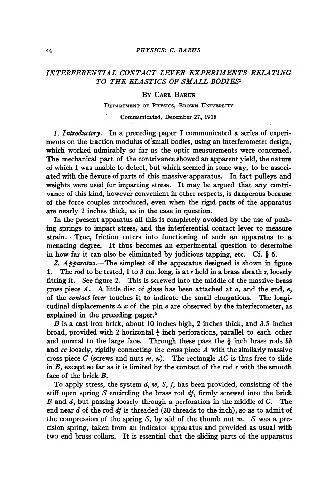
Introduction to "Interferential Contact Lever Experiments Relating to the Elastics of Small Bodies" (1918) Welcome to a detailed exploration of my scientific work, "Interferential Contact Lever Experiments Relating to the Elastics of Small Bodies," first published in 1918. Thi
Before you read
Welcome to a detailed exploration of my scientific work, "Interferential Contact Lever Experiments Relating to the Elastics of Small Bodies," first published in 1918. This book represents a highly specialized investigation into the mechanical properties of diminutive solid bodies, emphasizing the remarkable precision and application of interferometry in examining elasticity. It stands as both a practical and theoretical resource for scientists, researchers, and enthusiasts interested in material science, physics, and experimental methodology.
The advancements made in this study contribute to a deeper understanding of small-scale material behavior, especially in the context of stress, strain, and deformation under controlled conditions. This book outlines innovative techniques and provides a framework for modern investigations in the realm of elastodynamics, microengineering, and applied mechanics.
In "Interferential Contact Lever Experiments Relating to the Elastics of Small Bodies," the focus is placed on determining the elastic properties of small-scale solid objects through quantitative studies using interferometry. Specifically, I investigate how minute bodies respond to applied stress, showcasing the development and use of experimental setups like the contact lever system.
The significance of interferometry, a method that employs the interaction of light waves to measure minute displacements, became a cornerstone for these experiments. By pairing interferometry with highly sensitive lever mechanisms, the book describes groundbreaking techniques to measure the deformation and elastic behavior of bodies under varied conditions.
Several chapters delve into detailed observations of elastic coefficients, the hysteresis behavior of materials, and the influence of geometry on a body's response to mechanical forces. Through meticulously designed experiments, the text highlights not only the theoretical predictions but also the variations found in practical testing.
Ultimately, this research combined state-of-the-art instrumentation and scientific exploration to fill notable gaps in our understanding of the physical properties of small objects. The methodology and results remain highly relevant for researchers seeking precise measurements in modern engineering and physics applications.
"To measure is to observe; to observe, therefore, is to render marvels tangible by science."
"Elasticity, though ubiquitous in nature, reveals its secrets only to the inquisitive eye trained by experiment."
"Light, confined and controlled, serves as the most immaculate ruler in the scientist's arsenal."
This book remains an essential resource for its pioneering approach to the study of elasticity in small-scale materials. The precision achieved through interferometry combined with mechanical lever systems has set a foundation for various fields, from nanotechnology to applied physics. It is among the earliest works to advocate for a holistic combination of theoretical and practical methodologies in experimental science.
Additionally, the content is particularly enlightening for those working in cutting-edge areas like MEMS (Microelectromechanical Systems) and advanced material engineering, where the fundamentals of elasticity and precision measurement continue to play pivotal roles. By offering an in-depth perspective on 20th-century scientific progress, this book serves both as a historical document and as an instrumental guide for ongoing investigations.
In a broader sense, "Interferential Contact Lever Experiments Relating to the Elastics of Small Bodies" reiterates the importance of curiosity-driven research, demonstrating how seemingly niche experiments can lead to impactful scientific contributions. Its legacy underscores the timeless value of meticulous experimentation and the pursuit of understanding seemingly microscopic phenomena in grand detail.
Your question is answered in the context of this title and author. Each answer uses 2 points.
0 reviews, 3.0 average out of 5
Sign in to publish a review.
Ask a focused question and learn from the community.
Related references that continue this learning path.
Peter John &Sarah Cotterill &Liz Richardson &Alice Moseley &Gerry Stoker &Corinne Wales &Graham Smith
Rajeev Raman,Robert Sedgewick,Matthias F. Stallmann

George Greenstein,Arthur G. Zajonc

D. Petz (auth.),Fabio Benatti,Mark Fannes,Roberto Floreanini,Dimitri Petritis (eds.)