Book guide and evaluation
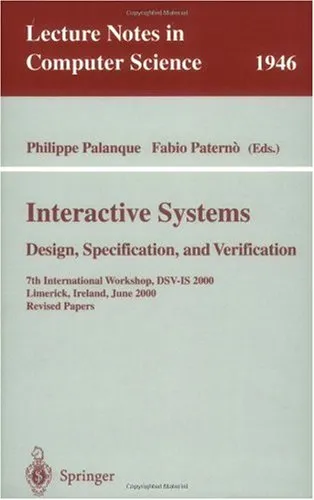
Interactive Systems Design, Specification, and Verification: 7th International Workshop, DSV-IS 2000 Limerick, Ireland, June 5–6, 2000 Revised Papers
Timothy N. Wright,T. C. Nicholas Graham,Tore Urnes (auth.),Philippe Palanque,Fabio Paternò (eds.)
English
Unordered
UI/UX
4.0 / 5
0 reviews
2001
Published
252
pages
433
views
Introduction to Interactive Systems Design, Specification, and Verification Modern human-computer interaction (HCI) is a rapidly evolving field, where improving the efficiency, safety, and usability of interactive systems lies at the forefront. The book "Interactive System
Before you read
What will you get from this book?
Introduction to Interactive Systems Design, Specification, and Verification
Modern human-computer interaction (HCI) is a rapidly evolving field, where improving the efficiency, safety, and usability of interactive systems lies at the forefront. The book "Interactive Systems Design, Specification, and Verification: 7th International Workshop, DSV-IS 2000 Limerick, Ireland, June 5–6, 2000 Revised Papers" serves as both a comprehensive resource and an intellectual exploration into the challenges and advancements in this area.
This compilation stems from the proceedings of the 7th International Workshop on DSV-IS 2000, where leading researchers, academics, and practitioners across the globe gathered to share their expertise on designing, specifying, and verifying interactive systems. The revised papers encapsulate innovative concepts, methodologies, and applications that significantly contribute to the development of safer, more reliable, and user-centered systems. As the HCI landscape continues to expand and diversify, the ideas presented in this book remain highly relevant to a wide audience including system designers, software engineers, usability experts, and researchers.
Detailed Summary of the Book
The book delves into the multifaceted nature of interactive systems, addressing various dimensions such as system modeling, task analysis, interaction paradigms, and validation techniques. It presents a thorough examination of how specifications and formal models serve as foundational tools when designing complex interactive systems.
The chapters reflect an interdisciplinary approach, integrating perspectives from computer science, psychology, and design. The contributors introduce new tools, methodologies, and frameworks while tackling challenges such as accessibility, human error modeling, and multi-modal interfaces. A key strength of the book is its focus on bridging the gap between theory and practice—providing practical insights for both novice and experienced professionals.
Key Takeaways
- Formal Specification Techniques: Explore the use of formal languages to define, analyze, and validate the behavior of interactive systems.
- Improved User-Centered Design: Learn methods to align system interfaces with user needs and cognitive processes.
- Error Identification and Mitigation: Gain insights into techniques for identifying and minimizing user errors through predictive modeling.
- Multi-Modal Interaction: Understand the implementation of systems that seamlessly integrate multiple forms of interaction, such as voice, touch, and gesture.
- Task and Workflow Analysis: Discover systematic approaches to analyzing user tasks to ensure workflow efficiency and effectiveness.
Famous Quotes from the Book
"Designing interactive systems is more than creating functionality; it’s about shaping experiences that resonate with the user’s cognitive and emotional patterns."
"A reliable system is not one that merely works but one that anticipates and mitigates potential points of failure."
"Accessibility isn’t a feature; it’s a fundamental requirement that ensures equitable access for all."
Why This Book Matters
This book is vital for professionals and scholars interested in the design and analysis of interactive systems. It not only provides a clear roadmap of existing and emerging methodologies but also emphasizes the importance of human-centric approaches in software and system design. As technology becomes an integral part of daily life, ensuring that interactive systems are both intuitive and robust is more critical than ever.
Furthermore, the book's exploration of formal methods enhances the reliability and safety of systems, particularly in domains like healthcare, aviation, and critical software systems. By presenting case studies, theoretical frameworks, and practical applications, this book bridges the gap between conceptual understanding and real-world implementation.
In conclusion, “Interactive Systems Design, Specification, and Verification” offers timeless insights that empower readers to create systems that are not only functional but are engaging and future-proof. Its cross-disciplinary approach ensures that it remains a core reference for those committed to innovation in interactive systems.
Ask this book
Your question is answered in the context of this title and author. Each answer uses 2 points.
Sign in to ask the book assistant.
Reader reviews
0 reviews, 4.0 average out of 5
No reviews yet
If you have read this book, help the next reader with your experience.
Write a review
Sign in to publish a review.
Reader questions and answers
Ask a focused question and learn from the community.
Sign in to ask or answer a question.
No questions yet
Be the first to ask a clear, useful question.
What to read next
Related references that continue this learning path.