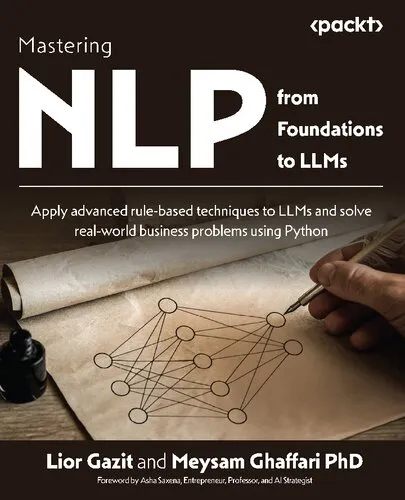
Mastering NLP from Foundations to LLMs: Apply advanced rule-based techniques to LLMs and solve real-world business problems using Python
Meysam Ghaffari,LIOR. GHAFFARI GAZIT (MEYSAM.)
2024
View book
Book guide and evaluation
Janne Sinkkonen,Samuel Kaski (auth.),Kwong Sak Leung,Lai-Wan Chan,Helen Meng (eds.)
0 reviews
Published
pages
views
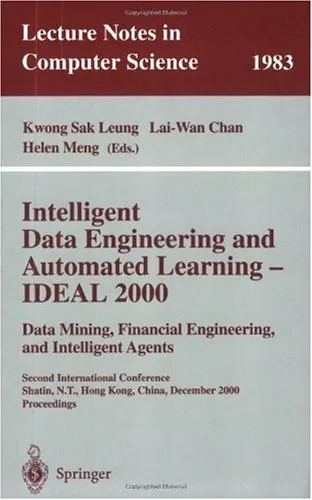
Introduction to "Intelligent Data Engineering and Automated Learning — IDEAL 2000" The book "Intelligent Data Engineering and Automated Learning — IDEAL 2000: Data Mining, Financial Engineering, and Intelligent Agents" provides a comprehensive overview of cutting-e
Before you read
The book "Intelligent Data Engineering and Automated Learning — IDEAL 2000: Data Mining, Financial Engineering, and Intelligent Agents" provides a comprehensive overview of cutting-edge research and advancements in the field of intelligent data engineering. With its basis grounded in the proceedings of the Second International Conference held in Shatin, N.T., Hong Kong, from December 13–15, 2000, this work presents an invaluable collection of insights from researchers, academics, and industry professionals. This volume encapsulates the synergy between automated learning techniques and their practical applications in data mining, financial modeling, and intelligent agent systems.
Published as part of the Springer Lecture Notes in Computer Science series, this book highlights the integration of advanced data engineering methodologies with real-world problem-solving across various fields. Whether it's predictive modeling in finance or the development of adaptive intelligent agents, IDEAL 2000 fosters robust discussions and solutions. The content is highly relevant for data scientists, engineers, AI researchers, and anyone working at the intersection of machine learning, automation, and data analytics.
The book is organized into multiple sections that represent the breadth of topics discussed during the IDEAL 2000 conference. Each chapter serves as a deep dive into a specific aspect of intelligent data engineering, including theoretical advancements, algorithmic innovations, and real-world applications. Topics covered include:
Each section is backed by comprehensive research, case studies, and mathematical rigor, ensuring readers have a grounded understanding of the state-of-the-art techniques. With contributors spanning academia and industry, the book bridges the gap between theoretical research and actionable insights for practitioners.
"The interplay between data and intelligent systems has never been more impactful, as we navigate an era of unprecedented data availability and computational power."
"Integrating learning mechanisms with real-world applications not only improves efficiency but opens up entirely new domains for exploration and innovation."
"The true potential of data engineering lies in its ability to bridge the gap between structured knowledge and adaptive solutions."
This book is a cornerstone in the field of intelligent data engineering, providing both foundational research and insights into future applications. The proceedings of the IDEAL 2000 conference serve not just as a summary of the state of the art in 2000 but as a predictor of many of the trends shaping today’s technological landscape. Its relevance is magnified by the multidisciplinary approach taken in addressing challenges in data mining, financial engineering, and intelligent systems development.
For researchers, this book is an essential resource that outlines methodologies and innovations applicable across industries. For practitioners, it serves as a guide to understanding the potential of data engineering in transforming conventional systems and enhancing decision-making frameworks. From its focus on intelligent agents to its exploration of dynamic data environments, IDEAL 2000 sets the groundwork for an era of AI-driven solutions.
In sum, "Intelligent Data Engineering and Automated Learning — IDEAL 2000" is both a reflection of monumental research efforts at the turn of the century and a timeless source of knowledge for professionals invested in shaping the future of intelligent systems.
Your question is answered in the context of this title and author. Each answer uses 2 points.
0 reviews, 3.5 average out of 5
Sign in to publish a review.
Ask a focused question and learn from the community.
Related references that continue this learning path.
Meysam Ghaffari,LIOR. GHAFFARI GAZIT (MEYSAM.)