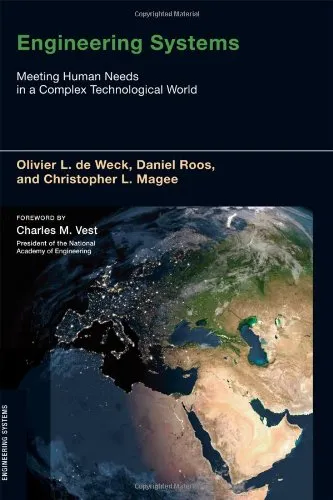
Engineering Systems: Meeting Human Needs in a Complex Technological World
Olivier L. de Weck,Daniel Roos,Christopher L. Magee,Charles M. Vest
2011
View book

Book guide and evaluation
F. Mavaddat; M. Mahmood
0 reviews
Published
pages
views
Integration, the VLSI Journalpp.239—266 VLSI circuit design, semiconductor integration Explore Integration, the VLSI Journalpp.239—266 for deep insights on advanced semiconductor integration strategies. Analytical Summary The work titled Integration, the VLSI Journalpp.239—
Before you read
The work titled Integration, the VLSI Journalpp.239—266 offers a rigorous and insightful exploration into the complexities of Very Large Scale Integration (VLSI) — a discipline at the frontier of modern electronics design. Authored by F. Mavaddat and M. Mahmood, this segment of the respected journal stands as a testament to technical mastery in semiconductor integration.
Within these pages, readers encounter meticulous analysis of architectural choices, fabrication processes, and optimization strategies that define the current and future landscape of VLSI. The text’s academic depth makes it a reliable reference for researchers, industry engineers, and graduate students who need both foundational principles and advanced methodologies.
While specific publication year information is unavailable due to the absence of reliable public sources, the content remains highly relevant in addressing enduring challenges in integration engineering and scaling of microelectronic systems.
From the analytical breadth and depth of Integration, the VLSI Journalpp.239—266, several key lessons emerge for the serious reader.
First, the centrality of design optimization across multiple layers — from circuit topology to semiconductor materials — is emphasized as the main driver of performance. Second, the authors highlight trade-offs inherent in scaling devices, underscoring the delicate balance between power efficiency, speed, and manufacturability. Finally, there is a steadfast focus on integration strategies that ensure functional reliability even at the most demanding levels of complexity.
"In VLSI design, integration is not merely a process — it is the art of harmonizing complexity with precision." Unknown
"Reliability emerges from an architect’s ability to anticipate the unseen stresses of operation." Unknown
The relevance of Integration, the VLSI Journalpp.239—266 stems from its dual role as both a detailed scholarly document and a practical guide for engineers working at the ever-tightening margins of electronic performance.
Given the accelerating pace of semiconductor innovation, industry professionals must rely on sources that combine theoretical rigor with empirical evidence. This work does precisely that — covering VLSI circuit design and semiconductor integration in ways that bridge academia and industry, theory and application. Its situational analyses of integration trade-offs enable better decision-making in contemporary and future projects.
Engaging with Integration, the VLSI Journalpp.239—266 invites readers into a realm where deep technical insight meets a vision for the future of integrated circuits. Whether you are an academic exploring cutting-edge theory or an engineer seeking applied solutions, this work serves as a beacon guiding you through the intricacies of VLSI design and semiconductor integration.
We encourage you to read, share, and discuss the analytical perspectives provided in these pages. By doing so, you contribute to the ongoing dialogue that shapes the evolution of integration technologies — a dialogue that originates from rigorous scholarship and culminates in transformational industry practice.
Your question is answered in the context of this title and author. Each answer uses 2 points.
0 reviews, 4.4 average out of 5
Sign in to publish a review.
Ask a focused question and learn from the community.
Related references that continue this learning path.
Olivier L. de Weck,Daniel Roos,Christopher L. Magee,Charles M. Vest