

The Big Fish Bang (Proceedings of the 26th annual Larval Fish Conference)
Howard I. Browman,Anne Berit Skiftesvik
2003
View book
Book guide and evaluation
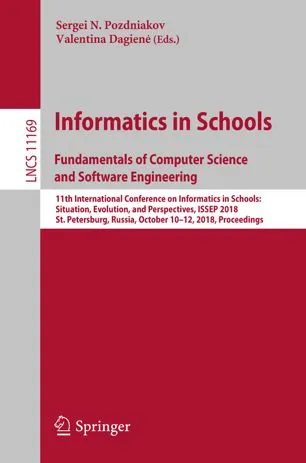
Sergei N. Pozdniakov,Valentina Dagienė
0 reviews
Published
pages
views
Introduction to the Book The book Informatics in Schools. Fundamentals of Computer Science and Software Engineering provides an expansive and thorough look at the evolving landscape of informatics education across the globe, focusing particularly on its challenges, methodologi
Before you read
The book Informatics in Schools. Fundamentals of Computer Science and Software Engineering provides an expansive and thorough look at the evolving landscape of informatics education across the globe, focusing particularly on its challenges, methodologies, and advancements in the context of schools. As the official proceedings of the 11th International Conference on Informatics in Schools (ISSEP 2018), held in St. Petersburg, Russia, this book serves as an essential resource for educators, researchers, and policymakers who are invested in shaping the future of computer science education at the school level. From foundational principles of teaching informatics to the exploration of innovative teaching techniques, the work encapsulates a broad spectrum of topics relevant to the cultivation of computational thinking in modern classrooms.
The conference brought together experts from around the world, all of whom share a commitment to enriching informatics education. The papers compiled in this book highlight both theoretical and applied research, portraying the dynamic interplay between pedagogy, curriculum design, and technology integration. With contributions from educators, software engineers, and curriculum developers, this book not only outlines the current "situation" but also charts the "evolution" and "perspectives" of teaching informatics—a timely and vital discussion in the digital age.
This introduction unpacks the core elements of the book and its relevance, delving into a detailed summary, key takeaways, notable insights, and the broader significance of this work within the context of informatics education.
At its core, the book is an academic anthology that highlights the efforts and results of the 11th ISSEP conference. Its content is meticulously structured to include diverse perspectives on the integration of computer science into school curriculums. Major topics include:
The diverse array of research compiled within the book reflects ongoing global interest in standardizing and innovating informatics education. It also underscores the importance of staying adaptive to educational trends and technological advances.
"Education in informatics should prepare students not only to use technology but also to understand and innovate with it, thereby shaping the digital future."
"The cornerstone of successful informatics education lies in fostering computational thinking—an intellectual skill that empowers students to approach problems systematically and express solutions clearly."
"Bridging the gap between education and emerging technologies ensures that the next generation is prepared to excel not just as consumers of technology, but as creators."
In a world increasingly driven by technology, the education sector must adapt rapidly to prepare students for the challenges and opportunities of the digital age. Informatics in Schools is a pivotal resource because it encapsulates global best practices, embraces innovation, and fosters interdisciplinary approaches. The book matters for several reasons:
Ultimately, this book is a call to action for stakeholders in education to reimagine and reframe how informatics is taught, ensuring that it remains forward-thinking and impactful in the decades to come.
Your question is answered in the context of this title and author. Each answer uses 2 points.
0 reviews, 4.5 average out of 5
Sign in to publish a review.
Ask a focused question and learn from the community.
Related references that continue this learning path.
Howard I. Browman,Anne Berit Skiftesvik

Philip J. Davis,Reuben Hersh,Elena Anne Marchisotto (auth.)
National Research Council; Committee on DoctoralandPostdoctoral Study in the United States

Jeffrey O. Bennett,Megan O. Donahue,Nicholas Schneider,Mark Voit