Roar! Get Heard in the Sales and Marketing Jungle: A Business Fable
Kevin Daum,Daniel A. Turner
2010
View book
Book guide and evaluation
Robert B. Cialdini
0 reviews
Published
pages
views
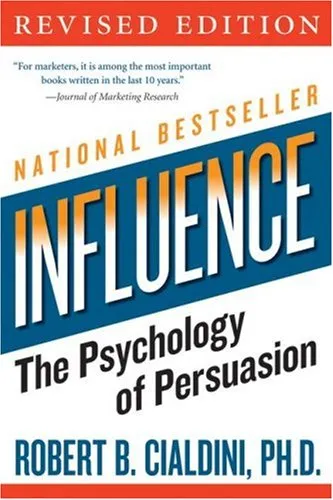
Introduction to 'Influence: The Psychology of Persuasion' In the realm of social psychology and marketing, few books have made as profound an impact as 'Influence: The Psychology of Persuasion'. Authored by the renowned psychologist Robert B. Cialdini, this work delves int
Before you read
In the realm of social psychology and marketing, few books have made as profound an impact as 'Influence: The Psychology of Persuasion'. Authored by the renowned psychologist Robert B. Cialdini, this work delves into the intricate dynamics of persuasion and the underlying principles that govern our everyday decision-making processes. Through extensive research and real-world examples, Cialdini presents a masterclass on the subtle art of influence, revealing the psychological tactics that lead to effective compliance and persuasion.
The book 'Influence: The Psychology of Persuasion' is based on extensive research and understanding of the principles of influence. Robert B. Cialdini articulates six universal principles that govern the acts of persuasion: Reciprocity, Commitment and Consistency, Social Proof, Authority, Liking, and Scarcity.
The principle of Reciprocity hinges on the human tendency to return favors, creating a cycle of giving and taking. Commitment and Consistency speak to our desire to align our behavior with our values and previous commitments, prompting us to stick to prior decisions. Through Social Proof, Cialdini explores our inclination to follow the crowd, especially in situations of uncertainty. Authority implies the trust and compliance we often afford to experts. The principle of Liking highlights that people are more likely to be influenced by those they like and relate to. Lastly, Scarcity is based on the idea that limited availability increases demand and desire.
Each principle is dissected in great detail, with Cialdini providing both the psychological rationale and real-world scenarios that illustrate their application. The book presents a framework that not only academics and marketers can use, but also anyone interested in understanding the complex mechanisms of persuasion.
"By concentrating our energies on the single 'path of least resistance,' we can often make the most headway with the most people."
"A well-known principle of human behavior says that when we ask someone to do us a favor, we will be more successful if we provide a reason."
"The tendency to be consistent is a strong one. Once we have made a choice or taken a stand, we will encounter personal and interpersonal pressures to behave consistently with that commitment."
‘Influence: The Psychology of Persuasion’ is a seminal text in understanding the mechanisms behind compliance and agreement. Its exploration into the psychological principles that dictate human interactions has made it a critical reference for professionals in marketing, business, and social sciences. In an age where information is abundant and attention is sparse, mastering the nuances of influence becomes essential for driving effective communication and change.
This book not only unveils how influence can be gained but also serves as a warning system, educating readers on how to recognize and defend against manipulation. Its ethical lens on influence ensures that persuasion techniques are used responsibly, making it an invaluable resource for those who wish to navigate the complex landscape of modern human interactions ethically and efficiently.
Your question is answered in the context of this title and author. Each answer uses 2 points.
0 reviews, 5.0 average out of 5
Sign in to publish a review.
Ask a focused question and learn from the community.
Related references that continue this learning path.
Kevin Daum,Daniel A. Turner